




THE MOST HOLY TRINITY: THE GOD WHO IS LOVE
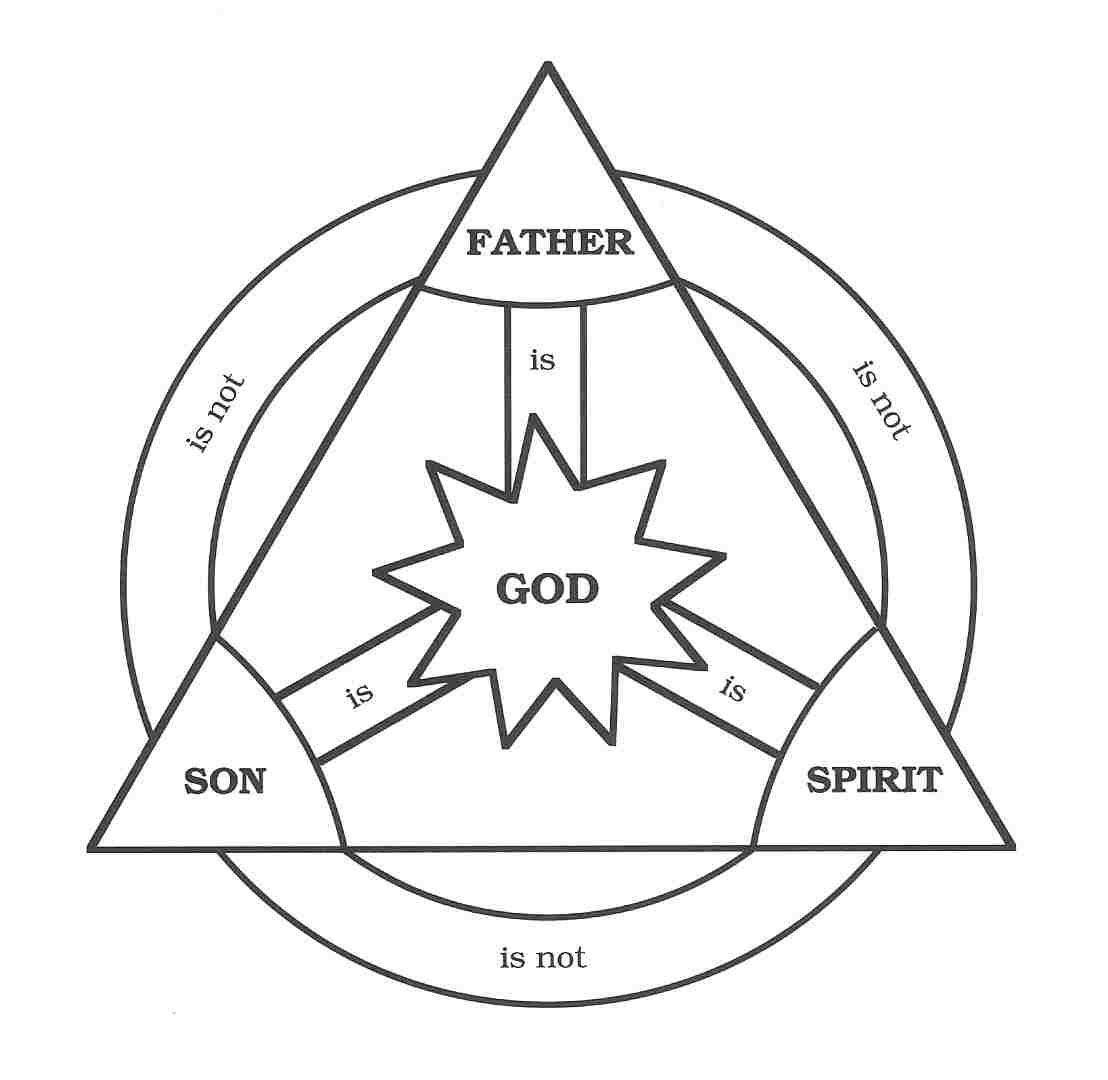
The Solemnity of the Most Holy Trinity invites us to contemplate the deepest mystery of our Christian faith. It is not merely a doctrine to be studied but a mystery to be adored, celebrated, and lived. The Trinity teaches us that there is one God in three distinct Persons: the Father, the Son, and the Holy Spirit. These three Persons are not three gods but one God, sharing the same divine nature, equal in majesty, glory, power, and eternity.
Human reason struggles before this mystery. How can three be one and one be three? The Trinity is not a mathematical puzzle to be solved but a divine reality to be embraced in faith. As Saint Augustine once observed, if we think we have fully understood God, then what we have understood is not God. The infinite God can never be completely contained within the finite human mind.
A beautiful story is often told about Saint Augustine. While walking along the seashore, he was deeply reflecting on the mystery of the Trinity. He noticed a little boy digging a hole in the sand and carrying water from the ocean with a small shell into the hole. Augustine asked the child what he was doing. The boy replied, “I am trying to put the whole ocean into this little hole.” Augustine smiled and explained that such a thing was impossible. The child then responded, “And it is even more impossible for your finite mind to contain the infinite mystery of God.” The child disappeared, and Augustine understood the lesson. The mystery of God is greater than the human intellect. We can know God truly because He has revealed Himself, but we can never know Him exhaustively.
Yet we firmly believe in the Holy Trinity because Jesus Christ revealed it. The Evangelists faithfully recorded His teachings. The Fathers of the Church reflected deeply on this mystery, and the great Councils of Nicaea (A.D. 325) and Constantinople (A.D. 381) solemnly defined it as a central dogma of Christian faith. The Trinity is therefore not a theological invention but a divine revelation.
The Holy Trinity Revealed in Sacred Scripture
The Old Testament contains hints and shadows of the Trinity, but the full revelation comes through Jesus Christ in the New Testament.
The Annunciation
At the Annunciation, we see all three Persons actively involved in the mystery of salvation. God the Father sends the angel Gabriel to Mary. The Holy Spirit comes upon her. The power of the Most High overshadows her. The Son of God takes flesh in her womb (Luke 1:26-38). The Incarnation is therefore a profoundly Trinitarian event.
The Baptism of Jesus
At the Jordan River, the Trinity is manifested publicly. Jesus, the Son, stands in the water receiving baptism. The Holy Spirit descends upon Him in the form of a dove. The Father’s voice is heard from heaven: “This is my beloved Son, with whom I am well pleased” (Matthew 3:13-17). Here heaven opens to reveal the inner life of God.
The Great Commission
Before ascending into heaven, Jesus commands His disciples: “Go therefore and make disciples of all nations, baptizing them in the name of the Father and of the Son and of the Holy Spirit” (Matthew 28:19). Notice that Jesus says “name,” not “names.” There is one divine name shared by the three Persons, revealing both unity and distinction within God.
Jesus’ Farewell Discourses
In John’s Gospel, especially chapters 14 through 17, Jesus reveals the intimate relationship among the Father, the Son, and the Holy Spirit. The Father sends the Son into the world. The Son redeems humanity through His death and resurrection. The Holy Spirit proceeds from the Father and the Son to guide, strengthen, sanctify, and teach believers. Salvation itself is the work of the Trinity.
The Trinity Throughout Salvation History
The Trinity is not only revealed in isolated moments of Scripture but throughout the entire history of salvation.
In creation, the Father speaks the world into existence, the Son is the eternal Word through whom all things were made, and the Spirit hovers over the waters (Genesis 1:1-3; John 1:1-3).
In Noah’s time, it was God who preserved humanity through the ark and established a covenant of mercy (Genesis 9:8-17).
At the Exodus, God the Father liberated His people, the prefigured Christ became the true Paschal Lamb, and the Spirit guided Israel through the wilderness.
At Pentecost, the Father fulfilled His promise, the risen Son sent the Spirit, and the Holy Spirit descended upon the Church with power (Acts 2:1-11).
The entire Bible is the story of the Father loving, the Son redeeming, and the Holy Spirit sanctifying.
Why the Holy Trinity Matters in Daily Christian Life
The Trinity is not a doctrine reserved for theologians. It shapes every aspect of Christian life.
Every prayer begins and ends with the Trinity. Whether consciously or unconsciously, Christians pray to the Father, through the Son, in the Holy Spirit.
Every sacrament is celebrated in the name of the Father and of the Son and of the Holy Spirit. We are baptized into the Trinity. We are confirmed by the Spirit. We receive Christ in the Eucharist. We are forgiven, healed, ordained, and married through the power of the Triune God.
The ringing of church bells traditionally reminds us of the mystery of the Incarnation and invites us to glorify the Trinity. The Angelus itself is a Trinitarian prayer.
Every time we make the Sign of the Cross, we profess our faith in the Trinity. What many do in a few seconds is actually a summary of the entire Christian faith. The Sign of the Cross reminds us who God is and whose we are.
Living the Mystery of the Trinity
Respect the Dignity of Every Human Person
Since the Holy Spirit dwells within us, every human person possesses immense dignity. We cannot claim to love God while despising those in whom God dwells. Every person we meet is someone loved by the Father, redeemed by the Son, and sanctified by the Spirit.
Trust in the Presence of God
The Trinity is not distant. God dwells within us. The Father watches over us, the Son walks with us, and the Holy Spirit strengthens us. In moments of fear, suffering, uncertainty, or temptation, we must remember that the Triune God remains our source of hope, courage, and strength.
Build Relationships of Love and Unity
The Trinity reveals that God’s very nature is communion and love. The Father eternally loves the Son, the Son eternally loves the Father, and the Holy Spirit is the bond of their perfect love.
Christian families are called to mirror this divine communion. The relationship among father, mother, and children should reflect mutual love, self-sacrifice, forgiveness, and unity. A family that loves, prays, and remains united becomes an icon of the Holy Trinity.
Live the Double Commandment of Love
Jesus teaches us to love God with all our heart and to love our neighbor as ourselves (Matthew 22:37-39). This creates a beautiful vertical and horizontal relationship. We reach upward to God through worship and prayer, and outward to our neighbor through charity and service. The closer we draw to God, the closer we should draw to one another.
Conclusion
The mystery of the Holy Trinity reminds us that at the heart of the universe is not loneliness, power, or domination, but love. God is an eternal communion of Persons united in perfect love. We were created by that love, redeemed through that love, and called to share forever in that love.
As we celebrate this great solemnity, may we not merely believe in the Trinity with our minds but reflect the Trinity with our lives. May our families become schools of love, our parishes communities of communion, and our hearts dwelling places of the Father, the Son, and the Holy Spirit.
To the Triune God, Father, Son, and Holy Spirit, be all glory and honor forever and ever. Amen. God bless you.
References and Sources
Sacred Scripture
- Genesis 1:1-3
- Genesis 9:8-17
- Isaiah 6:1-8
- Matthew 3:13-17
- Matthew 28:19
- Luke 1:26-38
- John 1:1-18
- John 14-17
- Acts 2:1-11
- Romans 8:14-17
- 2 Corinthians 13:13
- Ephesians 4:4-6
Catechism of the Catholic Church
- CCC 232-267 (The Mystery of the Most Holy Trinity)
- CCC 683-747 (The Holy Spirit)
- CCC 1996-2005 (Grace and Participation in Divine Life)
Church Fathers
- Saint Augustine, De Trinitate (On the Trinity)
- Saint Athanasius, Against the Arians
- Saint Gregory of Nazianzus, Theological Orations
Ecumenical Councils
- First Council of Nicaea (A.D. 325)
- First Council of Constantinople (A.D. 381)
Liturgical Sources
- Roman Missal, Solemnity of the Most Holy Trinity
- Preface of the Most Holy Trinity
- Nicene-Constantinopolitan Creed (Profession of Faith)

Thank you Fr. God bless you 🙏
Amen