


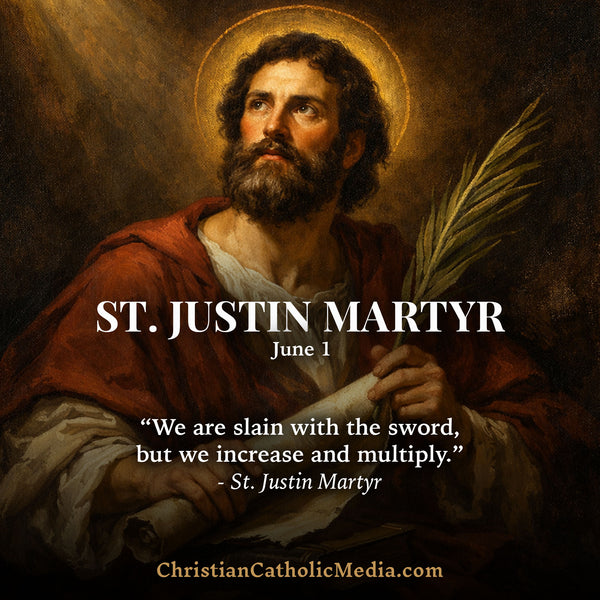
June 1 Monday: St, Justin, Martyr. Mk 12:1-12
Jesus tells the Parable of the Wicked Tenants during His final week in Jerusalem as a prophetic judgment against the religious leaders of Israel. Through this parable, He accuses them of failing to produce the fruits of repentance, justice, and faithfulness that God expected from His chosen people. Like a vineyard that yields sour grapes instead of good fruit, Israel’s leaders had failed in their mission and rejected God’s repeated calls to conversion.
In the parable, God is represented by the landowner, the vineyard symbolizes Israel, and the tenants represent the religious leaders entrusted with God’s people. The servants sent by the owner symbolize the prophets of the Old Testament, who were sent to call the people back to righteousness. Instead of listening to them, the people rejected, persecuted, and even killed the prophets. Finally, God sent His Son, Jesus Christ, expecting the fruits of obedience and holiness. But the tenants rejected and killed the Son as well. Consequently, the Kingdom of God would be entrusted to others who would bear its fruits, namely the Church composed of all who believe in Christ. The parable serves as a warning that privilege without faithfulness can lead to loss, and that every generation of believers must continually produce spiritual fruit.
Life Messages
1. We are called to be fruitful members of the Church.
God has provided everything necessary for our spiritual growth: Sacred Scripture to guide us, the Sacraments to strengthen us, the priesthood to shepherd us, the Eucharist to nourish us, Reconciliation to forgive us, Confirmation to empower us, Matrimony to sanctify family life, and the Anointing of the Sick to bring healing and grace. We are expected to make use of these gifts and produce the fruits of faith, holiness, charity, and service.
2. We are called to be fruitful within our families.
The family is a vineyard entrusted to our care. We bear good fruit by loving one another, sharing our blessings, sacrificing for the good of others, serving with humility, encouraging one another, forgiving generously, and honoring our parents. In this way, our homes become places where the Gospel is lived and where God’s love becomes visible through daily acts of kindness and self-giving. God bless you.
June 2 Tuesday: Sts Marcellinus and Peter, Martyrs. Mk 12: 13-17
Today’s Gospel presents one of the most brilliant responses of Jesus to a carefully designed trap set by His opponents. The Pharisees, together with the Herodians, approached Him with a politically charged question about paying taxes to the Roman emperor. The Jews were subject to several Roman taxes, including a census tax that was especially unpopular because it symbolized their subjection to pagan rule. If Jesus opposed the tax, He could be arrested by the Romans as a rebel. If He supported it, He risked losing the support of many Jews who resented Roman occupation. It seemed like an impossible dilemma.
Instead of answering directly, Jesus asked His challengers to show Him the coin used to pay the tax. Pointing to the image and inscription of Caesar on the coin, He asked whose likeness it bore. When they replied, “Caesar’s,” Jesus gave His famous answer: “Render to Caesar what belongs to Caesar and to God what belongs to God.” With this response, He escaped their trap and redirected attention to a deeper spiritual truth. The coin belongs to Caesar because it bears his image, but human beings belong to God because they bear His image and likeness (Genesis 1:26–27). Thus, while citizens have legitimate duties toward civil authorities, their highest allegiance belongs to God alone.
Jesus’ answer establishes a proper balance between religious and civic responsibilities. He neither rejects lawful authority nor allows political obligations to overshadow our relationship with God. His teaching reminds us that while earthly governments may claim certain rights, God has a claim on the whole person, because He is our Creator, Redeemer, and Lord.
Life Messages
1. We belong entirely to God.
Since we are created in God’s image, we must offer Him not merely a portion of our lives but our whole selves, our thoughts, actions, talents, possessions, and future.
2. We must be faithful in our spiritual duties.
Christians are called to participate actively in worship, prayer, Scripture reading, family devotions, and the moral and religious formation of their children.
3. We should be responsible citizens.
Paying taxes, obeying just laws, respecting public institutions, and contributing to the common good are important Christian responsibilities that support society and promote justice.
4. We should participate in public life.
Christians have a duty to contribute positively to society by voting responsibly, engaging in civic affairs, promoting moral values, and encouraging leaders to govern with integrity, justice, and concern for the common good. God bless you.
June 3 Wednesday: St Charles Lwanga and companions. Mk 12:18-27
During His final visit to Jerusalem, Jesus faced a series of challenges from the religious leaders who were determined to discredit Him. After successfully answering questions posed by the Pharisees and other groups, He was confronted by the Sadducees, who denied the resurrection of the dead because they found no explicit reference to it in the writings of Moses. Hoping to ridicule the belief in resurrection, they presented a hypothetical case of a woman who, according to the law of levirate marriage, successively married seven brothers, all of whom died without leaving children. They then asked whose wife she would be in the resurrection.
Jesus responded by exposing the weakness of their argument. First, He explained that life after the resurrection is fundamentally different from earthly life. Those who rise from the dead do not marry or are given in marriage because they share in the immortal life of God. Heavenly existence is not simply a continuation of earthly conditions but a transformed and glorified way of living in God’s presence.
Second, Jesus used the very books accepted by the Sadducees to prove the reality of the resurrection. Referring to God’s words to Moses at the burning bush, He reminded them that God said, “I am the God of Abraham, the God of Isaac, and the God of Jacob” (Exodus 3:6). Since God spoke of the patriarchs in the present tense long after their earthly deaths, Jesus concluded that they were still alive before God. Therefore, God is “not God of the dead, but of the living.” In this way, Jesus demonstrated from the Torah itself that eternal life and resurrection are real.
Through this teaching, Jesus reveals that death is not the end of human existence. Those who belong to God are destined for a new and glorified life in communion with Him. The resurrection is not merely a doctrine to be believed but a promise that gives hope and meaning to Christian life.
Life Message
We are called to live as resurrection people.
Faith in the resurrection should transform the way we live each day. We must not remain trapped in the tombs of sin, selfishness, resentment, or destructive habits. Instead, we are called to live with the joy, hope, and peace that come from knowing the Risen Christ. The promise of our own resurrection should inspire us to honor our bodies as temples of the Holy Spirit, pursue holiness, avoid sinful habits, and treat others with dignity, love, and humble service. By living in this way, we bear witness to the new life that Christ has won for us through His Death and Resurrection. God bless you.
June 4 Thursday: Mk 12:28-34
After Jesus successfully answered the Sadducees’ question about the resurrection, a scribe who admired His wisdom approached Him with a sincere question: “Which commandment is the first of all?” At the time of Jesus, Jewish teachers debated how the 613 commandments of the Law could be summarized into a single principle. Some tended to multiply rules and regulations, while others sought a concise statement that captured the essence of God’s will.
Jesus answered with remarkable clarity and depth. He first quoted the great confession of faith known as the Shema: “You shall love the Lord your God with all your heart, with all your soul, with all your mind, and with all your strength” (Deuteronomy 6:5). He then immediately added a second commandment from Leviticus: “You shall love your neighbor as yourself” (Leviticus 19:18). By joining these two commandments together, Jesus revealed that love of God and love of neighbor are inseparable. One cannot claim to love God while neglecting or mistreating those created in His image.
Jesus teaches that true religion is not merely about external observances, rituals, or legal requirements. It is fundamentally about a loving relationship with God that expresses itself in concrete acts of love toward others. Every human person bears the image and likeness of God and has been redeemed by Christ. Therefore, to love our neighbor is to honor God Himself. This love is not based primarily on emotions or feelings but on actions, sacrifice, compassion, forgiveness, and service. In the Gospel of Luke, Jesus further illustrates this truth through the parable of the Good Samaritan, showing that our neighbor includes anyone in need, regardless of social, ethnic, or religious differences.
Life Messages
1. We are called to love God wholeheartedly.
To love God with all our heart, soul, mind, and strength means placing Him at the center of our lives. His will must take precedence over our personal desires and ambitions. Such love is expressed through prayer, worship, obedience, trust, thanksgiving, repentance, and a sincere desire to grow in holiness. Loving God is not merely an emotion but a daily commitment to seek and do His will.
2. We are called to love our neighbor as ourselves.
God’s will is that we recognize His presence and dignity in every person. Genuine Christian love moves us to help, support, encourage, forgive, and pray for others without discrimination. We are called to love people regardless of their race, ethnicity, social status, wealth, education, age, or background. When we show kindness and compassion to others, we become living witnesses of God’s love in the world. God bless you.
June 5 Friday . St. Boniface, Bishop and Martyr. Mk 12: 35-37
In today’s Gospel, Jesus challenges the Pharisees and the teachers of the Law with a question that exposes the limitations of their understanding of the Messiah. Quoting Psalm 110, Jesus points out that King David, under the inspiration of the Holy Spirit, refers to the Messiah as “my Lord.” This creates a puzzle for those who believed that the Messiah would simply be a human descendant of David.
The Jews rightly expected the Messiah to come from the royal line of David, based on God’s promise that David’s kingdom would endure forever (2 Samuel 7:13). However, Jesus asks a profound question: if the Messiah is merely David’s descendant, how can David call Him “Lord”? In Jewish culture, a father or ancestor would never refer to a descendant as his superior. Therefore, the Messiah must be greater than David. He must be more than a human king.
The answer is found in the mystery of Christ’s person. Jesus is indeed the Son of David according to His human nature. Through His earthly lineage, He fulfills the promises made to David and Israel. Yet He is also the eternal Son of God. Thus, while He is David’s descendant according to the flesh, He is David’s Lord according to His divinity. This truth is proclaimed by the angel Gabriel at the Annunciation: “The Lord God will give Him the throne of David His father, and He will reign over the house of Jacob forever” (Luke 1:32-33). Likewise, Saint Paul teaches that Jesus was “descended from David according to the flesh” but was revealed in power as the “Son of God” through His Resurrection (Romans 1:3-4).
By asking this question, Jesus reveals His true identity. He is not merely a political liberator or earthly king. He is both fully human and fully divine, the promised Messiah, the Son of David, and the eternal Lord of all creation.
Life Messages
1. We must accept Jesus as both Lord and Savior.
Faith in Christ involves more than admiring His teachings or acknowledging His historical existence. We are called to recognize His divine authority and allow Him to guide every aspect of our lives.
2. We should make Jesus the King of our hearts.
Christ must reign over our thoughts, decisions, relationships, priorities, and ambitions. His Gospel should shape the way we live and the choices we make each day.
3. We must surrender ourselves completely to Him.
True discipleship means giving Jesus free access to every area of our lives. As His followers, we are called to imitate His humility, love, and selfless service, becoming instruments of His grace in the world.
4. We should imitate Mary’s response to God’s plan.
Just as the Blessed Virgin Mary accepted God’s will with faith and trust, we are invited to place our lives in Christ’s hands, allowing Him to accomplish His purpose in us and through us. Through such surrender, we discover the joy, peace, and fulfillment that come from living under the lordship of Christ. God bless you.
June 6 Saturday: St. Norbert. BishopMk 12:38-44
In this Gospel scene, Jesus confronts the religious leaders in the Temple and exposes the gap between outward religious appearance and true inner holiness. After engaging in debates with groups such as the Sadducees, Pharisees, scribes, and Herodians, He turns His attention to the moral shortcomings within “organized religion” of His time. He contrasts the pride and self-importance of the scribes with the quiet, sincere offering of a poor widow, showing that true greatness before God is not measured by status or outward display, but by humility and total trust in Him.
Jesus strongly criticizes the scribes for their pride and hypocrisy. Although they were respected as experts in the Law of Moses, many of them sought public recognition, honor, and privilege. They preferred places of prominence in society and enjoyed being treated with special respect. Their long prayers were often used not as genuine communication with God, but as a way of displaying their supposed holiness. In addition, Jesus condemns their exploitation of vulnerable people, especially widows, whom they were meant to protect. Instead, some of them took advantage of their trust and misused resources intended for the poor, revealing deep moral corruption beneath their religious appearance.
Against this backdrop, Jesus highlights the example of a poor widow who contributes two small coins in the Temple treasury. While others give large amounts from their abundance, she gives everything she has. Her offering, though materially small, is spiritually great because it represents complete trust in God and total self-giving. Jesus praises her as the one who has truly given more than all the others, because she has offered not just money, but her entire life to God.
Life Messages
1. We are called to support and value the vulnerable.
The Church is invited to recognize, appreciate, and care for widows and all who are in need, especially those who serve quietly in parish life, visit the sick, and contribute generously despite their limitations.
2. God looks at the heart, not appearances.
While human beings often judge by wealth, status, or outward success, Jesus evaluates people based on their intentions, sacrifices, and sincerity. True worth in God’s eyes is measured by love and authenticity.
3. True giving involves self-sacrifice and trust.
The widow teaches that real generosity is not about the amount given, but about the spirit in which it is offered. God values offerings that come from faith, trust, and total surrender, even when they appear small in human terms. God bless you.