




April 27 Monday: Jn 10:11-18
Jesus the Good Shepherd
In today’s Gospel, Jesus is in Jerusalem during the Feast of Dedication. The people gather around Him and ask a direct question: “Are you the Messiah?”
Instead of giving a simple “yes” or “no,” Jesus gives a deeper answer. He says:
“I am the Good Shepherd.”
What Jesus Means by “Good Shepherd”
1. He knows His sheep
Jesus Christ knows each one of us personally.
- He knows our strengths and weaknesses
- He knows our struggles and desires
- He loves us just as we are
And He speaks to us:
- In the Bible
- At Mass
- Through the Sacraments
- Through parents, priests, and life situations
The question is: Do we listen to His voice?
2. He gives us eternal life
Jesus does not just guide us, He gives us life that never ends.
He nourishes us through:
- Baptism (we become part of His flock)
- Confirmation (we receive strength from the Holy Spirit)
- Holy Eucharist (we receive spiritual food)
Through these, Jesus keeps us spiritually alive and growing.
3. He protects His sheep
Jesus places us safely in the hands of God the Father.
Without Him, we are vulnerable to dangers like:
- Sin
- Temptation
- Evil influences
But with Him, we are safe.
Life Message for Us
1. Be a good shepherd
Each of us is responsible for others, family, friends, parish members.
- Care for them
- Pray for them
- Guide them
- Protect them from harm
2. Be a good sheep
Being a Christian also means being a good follower.
- Listen to God’s word
- Participate in Mass
- Receive the Sacraments
- Respect and support your pastors
Simple Line to Remember
“A good sheep listens to the Shepherd, a good shepherd cares for the sheep.”
Final Thought
Jesus is always speaking.
The real question is not whether He speaks,
but whether we are listening and following. God bless you.
April 28 Tuesday: St. Peter Chanel, Priest, Martyr / St. Louis Grignion de Montfort, priest. Jn 10:22-30
“I and the Father are One”
It was winter in Jerusalem, during the feast of Hanukkah, also called the Festival of Lights. The people remembered how the Temple was cleansed and rededicated after being defiled.
During this feast, Jesus Christ was teaching in the Temple. The Jews surrounded Him and asked a direct question:
“Are you the Messiah?”
They were expecting a powerful political leader, someone who would defeat their enemies and restore Israel’s glory.
Jesus’ Powerful Reply
1. Believe the works, not just your expectations
Jesus did not simply say “yes.” Instead, He pointed to His actions:
- His miracles
- His teachings
- His authority
He challenged them:
Look at what I do, and you will know who I am.
But they refused to believe, not because there was no evidence,
but because their hearts were already made up.
2. Unbelief comes from a closed heart
Jesus said something very direct:
“You do not believe because you are not my sheep.”
Faith is not just about intelligence,
it is about openness to God.
- Some saw miracles and believed
- Others saw the same miracles and rejected Him
The difference was the condition of the heart.
3. His sheep are safe
Jesus gives a beautiful promise:
- Those who listen to Him
- Those who follow Him
Will receive eternal life.
They are held securely in God’s hands.
No evil can overcome them when they remain with Him.
4. The greatest claim: Jesus is God
Then Jesus makes a bold declaration:
“I and the Father are one.” (John 10:30)
This means:
- He is not just a prophet
- Not just a teacher
- He shares the very nature of God
This is why the people reacted strongly,
because they understood exactly what He was claiming.
Life Message for Us
1. When doubts come, seek the truth
Faith can be challenged.
- Read Scripture
- Learn the teachings of the Church
- Ask questions
- Pray for guidance
God is not afraid of your questions.
2. Stay in the “sheepfold”
We remain safe when we stay close to God through:
- Reconciliation
- Holy Eucharist
- Prayer
- The Word of God
Simple Line to Remember
“Faith grows where the heart is open.”
Final Thought
The problem was not that the people did not hear Jesus.
The problem was that they refused to accept Him.
Today, Jesus is still speaking.
The question is:
Are we truly listening, or are we holding on to our own expectations? God bless you.
April 29 Wednesday: St. Catherine of Sienna, Virgin, Doctor of the Church. Jn 12:44-50
Jesus the Light and Life of the World
Today’s Gospel, from the Gospel of John, comes from the final public teaching of Jesus Christ before His suffering and death.
In this passage, Jesus reveals three powerful truths about Himself.
1. Jesus is One with the Father
Jesus tells us that He is perfectly united with God the Father.
- What He says, the Father says
- What He does, the Father does
So, to accept Jesus is to accept God.
To reject Jesus is to reject God.
2. Jesus is the Light and Life of the World
Jesus says He is our Light.
- He removes the darkness of sin
- He shows us the right path in life
- He fills us with love and hope
As Psalm 27 says:
“The Lord is my light and my salvation.”
Jesus is also our Life.
- His word gives us spiritual life
- His presence strengthens our faith
- His grace leads us to eternal life
3. Jesus will be our Judge
Jesus reminds us that our final destiny depends on our response to Him.
- If we accept Him and live by His teachings → Eternal Life
- If we reject Him → Separation from God
It is not enough to say we believe.
We must live what we believe.
Life Message for Us
1. Be light in the world
We are called to reflect Jesus in our daily lives:
- Show love
- Practice forgiveness
- Be kind
- Serve others humbly
Let people see Jesus through you.
2. Choose Jesus every day
Faith is not a one-time decision.
We must choose Christ:
- In our thoughts
- In our words
- In our actions
Ask the Holy Spirit for strength to do what is right.
Simple Line to Remember
“If Jesus is our Light, then our lives must shine.”
Final Thought
Darkness is real in the world,
but light is stronger.
When we stay close to Jesus,
we don’t just walk in the light,
we become light for others.
God bless you.
April 30 Thursday: St. Pius V , Pope. Jn 13:16-20.
The Gospel passage following the Mandatum the washing of the feet serves as a profound ecclesiological blueprint for the Church. Christ establishes that the authority of His messengers is inextricably linked to their identity as diakonos (servants). When the disciple stoops to serve, they do not diminish their office; rather, they illuminate the very presence of the Master within them.
Theological Reflection: The Servant-Messenger
The hallmark of Christian discipleship is a radical, sacrificial availability to the “other.” In the first movement of this text, Jesus clarifies that greatness in the Kingdom is measured by the depth of one’s descent into service. Just as the high priest in the Old Covenant underwent ritual washings, Christ performs a new ritual of purification—not with the blood of goats, but through the humility of water and the impending sacrifice of His own Body. We are commanded to “do likewise,” transforming every act of charity into a liturgical extension of the Last Supper.
The Mystery of Betrayal and Mercy
The second movement addresses the piercing reality of disloyalty. Jesus invokes the sorrow of David in Psalm 41:9, identifying the “lifting of the heel” as the ultimate breach of table fellowship. Yet, His response to Judas is not one of excommunication, but of intensified intimacy. By offering the psomion (the morsel), Jesus reaches out to the betrayer with the same hands that just washed his feet. This mirrors the enduring patience of God seen in Hosea 11, where the Lord refuses to give up on a faithless Israel. It challenges us to offer the “morsel of peace” even to those who have already turned their backs on us.
The Foundation of Apostolic Authority
Finally, Christ provides the theological anchor for Apostolic Succession. He declares a divine chain of reception: to welcome the sent one (apostolos) is to welcome the Son, and by extension, the Father. This mirrors the ancient principle of Shaliach, where a person’s representative is treated as the person themselves. The authority of the Church, therefore, is not a secular power but a sacramental presence, valid only as long as the messenger remains rooted in the humility of the Sender.
Practical Application for the Faithful
• Embodying the Mandate: Our identity as Christians is verified not by our titles, but by our willingness to perform “foot-washing” tasks in our daily lives acts of service that are often unseen and unthanked.
• The Path of Reconciliation: We are called to imitate Christ’s “unrestricted grace” toward those who offend us. This involves active intercession for our enemies and a refusal to withhold love, even when betrayal is imminent, trusting that God’s justice is preceded by His mercy. God bless you.
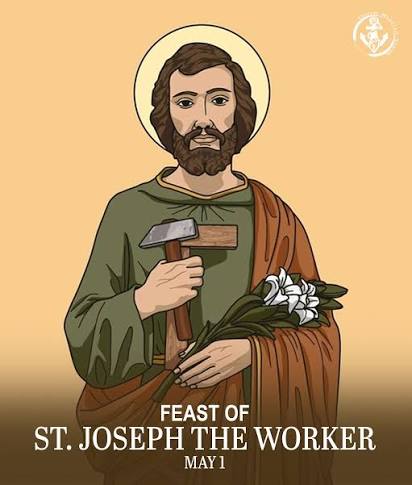
May 1 Friday:Feast of St. Joseph the Worker. Jn 14-1-6
In response to the May Day celebrations in Communist countries, where workers were reduced to mere “cogs in the machine,” Pope Pius XII instituted the feast of St. Joseph the Worker. The goal was to Christianize the concept of labor, restore its true dignity, and provide all workers with a powerful heavenly patron and role model.
Theology of work: Sacred Scripture presents God Himself as a worker. From the very beginning, “In the beginning God created the heavens and the earth” (Gen 1:1). The Father is continually at work in creation and providence. He entrusts to His Son Jesus the work of human redemption, and to the Holy Spirit the work of our sanctification. This is why Jesus could declare, “My Father is working still, and I am working” (Jn 5:17). After the tragic fall of Adam and Eve, God commanded man to work: “By the sweat of your face you shall eat bread” (Gen 3:19). Jesus Himself honored the necessity and nobility of work by laboring quietly as a carpenter in Joseph’s workshop until the beginning of His public ministry of preaching and healing. Work is noble not only because it fulfills God’s command, but also because it sustains families, builds communities, and contributes to the common good of society.
Joseph as an exemplary worker: Joseph earned his living and supported the Holy Family through honest carpentry, skillfully serving his neighbors. He was a just worker, truthful in purchasing materials, fair in pricing his finished products, and upright in all his dealings. He was a devoted working father who labored diligently for his family. He was a praying worker who remained close to God, receiving divine guidance through dreams at critical moments and maintaining God’s presence even in his daily workshop. He was an obedient worker who faithfully observed the Mosaic Law of Sabbath rest, using that holy day to bring Jesus to the synagogue and to teach Him the Law given through Moses.
Life messages: 1) Let us recognize and appreciate the dignity of all honest work and all types of laborers, since through their efforts they glorify God and advance the welfare of society. 2) Let us strive to be sincere and committed in our own work, following St. Joseph’s example by laboring in constant awareness of God’s presence. 3) Let us love our daily work and transform it into prayer by consciously offering it for God’s greater glory. God bless you.
May 2 Saturday: St. Athanasius, Bishop, Doctor of the Church. Jn 14:7-14
today’s Gospel selection, Jesus responds to Philip’s request at the Last Supper by revealing the perfect unity and oneness of the Three Persons of the Most Holy Trinity, Father, Son, and Holy Spirit. He clarifies the mutual indwelling of each Divine Person: the Father in the Son, the Son in the Father, and the Holy Spirit proceeding from both. Thus, Jesus is the visible image of the invisible God. He identifies Himself completely with the Father, declaring that at every moment He does exactly what the Father commands (Jn 5:30; 8:28-29, 38).
To see what God is like, we need only look at Jesus. To hear how God speaks, we need only listen to Jesus. In Him we behold the perfect love of God, a God who cares deeply, who yearns for every man and woman, and who loves them to the point of laying down His life on the Cross. Jesus has made visible a God who loves us unconditionally, unselfishly, and perfectly. If we trust in Jesus and believe in Him, He promises that the Father will hear our prayers when we ask in His Name. This is why Jesus taught His followers to pray with confidence: “Our Father who art in heaven… give us this day our daily bread” (Mt 6:9,11; Lk 11:2-3).
Life message: 1) We believe that God dwells within our souls through the Holy Spirit, making each of us a living temple of the Triune God, Father, Son, and Holy Spirit. As St. Paul reminds us, “Do you not know that you are God’s temple and that God’s Spirit dwells in you?” (1 Cor 3:16). 2) Hence, it is our duty to live always conscious of this real presence of the Triune God within us, adjusting our daily conduct accordingly, doing good to others and steadfastly avoiding evil. God bless you.


God bless you too
Amen