




Deuteronomy 8:2-3, 14b-16a
1 Corinthians 10:16-17
John 6:51-58
INTRODUCTION
The Solemnity of Corpus Christi, officially known as the Solemnity of the Most Holy Body and Blood of Christ, originated in the thirteenth century as a special feast dedicated to honouring and deepening faith in the Real Presence of Christ in the Eucharist. Its development was strongly influenced by the Eucharistic visions of St Juliana of Liège (1193–1258), an Augustinian nun from present-day Belgium, who consistently advocated a liturgical feast devoted specifically to the Blessed Sacrament outside the context of Holy Thursday. Her efforts gained support from theologians and Church leaders, including Jacques Pantaléon, who later became Pope Urban IV. In 1264, Pope Urban IV formally extended the feast to the universal Church through the papal bull Transiturus de hoc mundo, encouraged in part by the reported Eucharistic miracle of Bolsena, in which a consecrated host was said to have bled during Mass. St Thomas Aquinas was commissioned to compose the liturgical texts for the feast, including celebrated Eucharistic hymns such as Pange Lingua and Tantum Ergo. Over the centuries, Corpus Christi became widely associated with Eucharistic processions, public adoration, Benediction of the Blessed Sacrament, and renewed devotion to Christ truly and substantially present in the Holy Eucharist.
OVERVIEW OF THE READINGS
The Book of Deuteronomy recalls Israel’s forty years in the wilderness, where God fed the people with manna in order to teach them that human life depends not only on material food but also on every word that comes from the mouth of God. The First Letter to the Corinthians explains that the cup of blessing and the bread we break bring about a real participation in the body and blood of Christ, uniting believers into one body despite their differences. In the Gospel of John, Jesus presents himself as the living bread come down from heaven and declares that whoever eats his flesh and drinks his blood will have eternal life and remain in communion with him. The common theme uniting all three readings is divine nourishment. God feeds his people physically and spiritually, sustaining not only bodily life but also the covenant relationship that binds them to him and to one another.
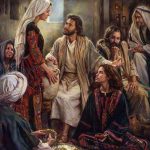
My dear People of God, the Gospel reading from John takes us to the heart of today’s solemnity. Jesus presents himself as the Bread of Life. The setting is important. Jesus had already fed five thousand people with five loaves and two fish. The crowd followed him because they desired more bread. However, Jesus wanted to lead them beyond material hunger to a deeper hunger of the human soul. He declares: “I am the living bread that came down from heaven. Whoever eats this bread will live for ever. The bread that I shall give for the life of the world is my flesh.” These words shocked many listeners. Some even turned away from Jesus because of this teaching. Yet Jesus did not retreat or weaken his message. Instead, he repeated it with greater emphasis. He insisted that unless people ate his flesh and drank his blood, they would have no life within them. The Eucharist is not simply a memorial of something that happened long ago. It is the continuing presence of Christ among his people. Jesus promises eternal life, resurrection on the last day, and abiding communion: whoever receives him remains in him, and he in them.
Let me share a story. A woman inherited a small house from a distant relative. At first glance, it looked neglected and uninviting. Yet she gradually repaired it, cleaned it, and moved into it. Over time, it ceased to be merely property. It became home. She lived there, and it shaped her life. That is something of what happens in the Eucharist. Christ does not simply visit us briefly. He dwells within us, and we are invited to make our dwelling in him. Cyril of Alexandria teaches that Christ enters into a deep and enduring union with believers through the Eucharist, binding them to himself in communion (Commentarius in Joannem IV, 2). Cyril of Jerusalem teaches that participation in the Eucharist transforms believers, drawing them into the life of Christ and strengthening them spiritually (Catecheses Mystagogicae IV, 3).
Dear brothers and sisters in Christ, the second reading from the First Letter to the Corinthians brings us into the centre of Christian worship and community life. St. Paul speaks about the Eucharist not merely as a religious ritual but as a profound participation in the life of Christ. The Christians in Corinth lived in a divided society. Social class, wealth, and religious loyalties often separated people. Even within the Christian community there were tensions and divisions. Yet Paul reminds them that the Eucharist demands unity. He asks: “The cup of blessing that we bless, is it not a sharing in the blood of Christ? The bread that we break, is it not a sharing in the body of Christ?” Paul teaches that the Eucharist is much more than a symbol. In receiving Holy Communion, believers enter into real communion with Christ himself. Then Paul explains the consequence: because there is one bread, we who are many become one body. Many grains form one loaf. In the same way, people from different ethnic groups, families, professions, and backgrounds become one in Christ. This teaching challenges us deeply. It is impossible to receive Holy Communion sincerely while refusing reconciliation, forgiveness, or charity.
Let me share another story. A group of neighbours lived on the same street, but none spoke to one another. Suspicion and distance shaped their relationships. One winter evening, a powerful storm damaged electricity lines and left the neighbourhood in darkness. An elderly widow invited everyone into her modest house to share a warm meal. As they ate together, stories were shared, laughter emerged, and barriers slowly began to disappear. The meal did not simply symbolise unity; it created it. In a similar way, the Eucharist creates communion among believers. John Chrysostom teaches that one cannot honour Christ present on the altar while neglecting Christ present in one’s neighbour (Homilies on First Corinthians 24.2). Augustine teaches that participation in the Eucharist strengthens our loyalty to Christ and draws us away from attachments that divide the heart (Contra Faustum XX, 13).
Finally, dearly beloved, the first reading from the Book of Deuteronomy invites us to look back at one of the most significant moments in Israel’s history: the forty years in the wilderness. The Israelites had been delivered from slavery in Egypt through God’s mighty hand. Yet freedom from slavery did not immediately mean maturity in faith. They had left Egypt physically, but Egypt still remained in their hearts. They grumbled, complained, doubted, and sometimes longed to return to their former condition. Therefore, before entering the promised land, they had to undergo a period of formation. The wilderness was harsh—a place of uncertainty, thirst, hunger, fear, and danger. Yet it was also the place where God formed his people. Sometimes God teaches us not in moments of comfort but in seasons of difficulty. The Israelites learned that survival did not depend solely on their strength, intelligence, or planning. Rather, it depended on God’s providence. God fed them with manna, a food unknown to them. Every morning, the people gathered enough for the day. They were not allowed to hoard it for tomorrow. In this way, God was teaching them trust. They had to depend on him each day. The wilderness became a school of faith.
Let me share a brief story. A young man inherited a large farm from his father. In the beginning, he worked diligently and thanked God for every successful harvest. However, as the years passed, he became increasingly proud. He began to believe that his own intelligence and skill alone had made him prosperous. Then came a season of severe drought. The crops failed, the livestock weakened, and his confidence collapsed. Sitting alone in his empty barn, he remembered his father’s words: “The land belongs to God. You are only a steward.” The hardship taught him what success had caused him to forget. Israel learned a similar lesson in the wilderness. Clement of Alexandria teaches that dependence on God is not a sign of weakness but the foundation of authentic life (Paedagogus I, 7). Tertullian sees in God’s care for Israel a preparation for Christ, through whom divine life would later be given fully to humanity (De Baptismo 9).
Dear friends in Christ, today’s solemnity invites us not only to believe in the Eucharist but also to live Eucharistically. To live Eucharistically means to become what we receive. Christ gives himself completely for us, and we are called to give ourselves generously to others. We cannot receive the Bread of Life and remain indifferent to suffering, injustice, loneliness, or poverty around us. The Eucharist should make us more forgiving, more compassionate, more generous, and more attentive to those in need. When we leave Mass, we are sent forth to become living signs of Christ’s love in the world.
THE REFLECTION IN A NUTSHELL
Jesus promises that whoever eats his flesh and drinks his blood has eternal life, will be raised on the last day, and will remain in him as he remains in them. When we drink the cup of blessing and eat the broken bread, we enter into real communion with Christ’s body and blood, and this communion makes us one body despite our differences. God fed Israel in the wilderness with manna, teaching his people that true life comes from every word that proceeds from his mouth. The Eucharist fulfils that wilderness provision because Christ gives us not simply bread from heaven but himself as the living bread. The manna sustained Israel for a season; the Eucharist nourishes us for eternal life. Having received such a gift, we are called to become what we receive: the body of Christ for the life of the world.

![THE MOST HOLY BODY AND BLOOD OF CHRIST [Yr. A] “CORPUS CHRISTI” (June 7, 2026) Dt 8:2-3,14b-16a; I Cor 10:16-17; Jn 6:51-58) By: Rev. Fr. Clifford Atta Anim.](https://frcliffordhomilies.com/wp-content/uploads/2026/06/IMG_3230-150x150.jpeg)