



Jan 19 Monday:Mk 2:18-22
Today’s Gospel passage presents Jesus’ response to a sincere question raised, most likely by some well-meaning Pharisees and disciples of John the Baptist. They wondered why Jesus’ disciples ate, drank, and celebrated, while they themselves, and the Pharisees in general, fasted and prayed. Prayer, fasting, and almsgiving were the three central religious practices of Jewish life and were considered essential expressions of faithfulness to God.
Jesus’ reply.
Jesus answers their question using three powerful metaphors, the children of the bridal chamber, the patch on an old garment, and the wineskins. First, he compares his disciples to the children of the bridal chamber. These were close friends of the bride and groom who rejoiced and feasted with them throughout the wedding celebration. No one expected them to fast during such a joyful occasion. Jesus explains that as long as the Bridegroom is with them, fasting is inappropriate. However, the time will come when the Bridegroom is taken away, and then they will fast.
Here, Jesus teaches that fasting becomes necessary when sin weakens our union with him, when selfish habits and sinful tendencies begin to take control of our lives. As Christians, we are blessed with the continuing presence of Christ, especially in the Eucharist. We are therefore called to embrace both the joys and the crosses of Christian life. Joy remains the defining mark of the Christian, even in times of suffering and trial.
Jesus then uses the images of patching an old garment with new, unshrunken cloth and pouring new wine into old wineskins. Both images point to the same truth. Without openness and flexibility, the new will destroy the old. Through these metaphors, Jesus challenges his listeners to expand their minds and hearts in order to receive the newness of his message, which in many ways went beyond traditional Jewish religious practices. He calls for a radical interior transformation that allows God’s grace to renew us from within, so that we may reflect his love, mercy, and forgiveness to others.
Life message.
First, we are called to be adaptable Christians, with open and flexible minds and hearts. The Holy Spirit continues to work actively in the Church, guiding her teaching authority and enabling her to respond to new situations with fresh insights, renewed practices, and deeper understanding. We are therefore called to follow the teachings of the Church with generosity and goodwill, while remaining firmly rooted in Sacred Scripture, both Old and New Testaments, and in Sacred Tradition.
Second, we must strengthen our spiritual lives through prayer, fasting, and penance, especially when sin distances us from Christ. These practices help restore our relationship with God and prepare our hearts to receive the joy and freedom that come from living fully in communion with him. God bless you.
Jan 20 Tuesday: St. Fabian, Pope, Martr; St. Sebastian Martyr. Mk2:23-28
Today’s Gospel passage presents Jesus’ teaching on the true purpose of the Sabbath and how it is meant to be observed. This teaching comes in response to criticism and a rather petty accusation made by the Pharisees against Jesus’ disciples. On a Sabbath day, the disciples, being hungry, plucked ears of grain from a field, rubbed them between their palms to remove the husks, and ate the grain. The Pharisees accused them of breaking the Sabbath law by engaging in three forbidden actions, harvesting, threshing, and winnowing.
Jesus’ response.
Jesus defends his disciples by offering three strong arguments drawn from Sacred Scripture.
First, basic human needs take precedence over ritual observance. Jesus reminds them of the incident involving David and his men, who were hungry and in need of food. The priest Ahimelech gave them the consecrated bread, which by law was reserved for priests alone. Yet this act was not condemned because preserving human life and dignity is more important than strict ritual rules.
Second, Jesus explains that no law can stand in the way of authentic worship of God. He points out that priests work on the Sabbath by preparing sacrifices in the Temple, yet they are not guilty of violating the law. This shows that the Sabbath law was never meant to block genuine service to God.
Third, Jesus brings the argument to its deepest level by quoting the prophet Hosea, “I desire mercy, not sacrifice.” With this statement, Jesus teaches that compassion, love, and mercy are at the heart of God’s law. Any religious practice that ignores human suffering or need misses the very purpose of the law.
Through these arguments, Jesus makes it clear that the Sabbath was created to serve human beings, not to enslave them. It is meant to promote life, freedom, worship, and mercy.
Life messages.
Like the Jewish Sabbath, the Christian Sunday is meant to be a sacred gift rather than a burden.
First, it is a day for rest and refreshment, especially with family members, allowing bodies and minds to recover from the week’s labor.
Second, it is a day of thanksgiving and spiritual renewal, above all through participation in the Eucharistic celebration for Catholics, and through communal worship for other Christians.
Third, Sunday should be a time when parents intentionally teach their children the faith, through Scripture reading, prayer, and simple conversations about God.
Fourth, it is a fitting day for works of charity, visiting the sick, helping neighbors, and serving in parish activities.
Finally, Sunday is a day for healthy social interaction, strengthening bonds with family, neighbors, and fellow parishioners, reflecting the joy and freedom God intends for his people.
In all this, Jesus reminds us that true holiness is measured not by rigid rule-keeping, but by love, mercy, and a heart that seeks to honor God while caring for others.
Jan 21 Wednesday: St. Agnes, Virgin, Martyr. Mk 3:1-6
Today’s Gospel describes a miraculous healing performed by Jesus on a Sabbath day. This healing was a deliberate and public action meant to show that God’s true intention for the Sabbath is to do good and to save life, not to do evil or to destroy life.
The incident and the reaction.
In the Old Testament, the commandment to keep the Sabbath holy is clearly stated in Exodus 20:8 and Deuteronomy 5:12. However, over time, the scribes and Pharisees expanded this divine command by adding many man-made rules. Through their narrow interpretations, they made Sabbath observance so complicated that ordinary people found it almost impossible to keep it perfectly.
Jesus wanted to restore the original meaning God intended when He declared the Sabbath holy. For Jesus, the Sabbath was a day set apart for rest, worship, learning and teaching God’s law, and above all, for doing good to others. It was never meant to become a burden or a trap.
To make this point clear, Jesus healed a man with a withered hand in the synagogue, immediately after the worship service. By choosing to heal on the Sabbath, Jesus showed that acts of mercy and compassion are not violations of God’s law but its fulfillment. This action, however, angered the scribes and Pharisees, who were more concerned with legal observance than with human suffering.
Life messages.
First, our Catholic Christian Sabbath, Sunday, especially our participation in the Eucharistic celebration, is meant to recharge our spiritual batteries so that we can do good to others and resist evil in our daily lives.
Second, Sunday worship is meant to be an offering of our lives to God. At the altar, we ask for pardon and forgiveness for our sins, present our needs before the Lord, and share in the Divine Life through Holy Communion.
Third, Sunday is also a day for strengthening family life and community bonds. It is a time to spend with family members, to participate in parish activities, and to be present to our neighbors, living out the mercy and goodness we celebrate in worship.
Through this Gospel, Jesus reminds us that true Sabbath observance is measured not by fear of breaking rules, but by love, mercy, and concern for human life.
Jan 22 Thursday Mk 3:7-12
Today’s Gospel describes how both Jews and Gentiles from Galilee and the surrounding regions gathered around Jesus almost every day during his public ministry. They came because Jesus preached the Good News of God’s love and revealed, through his healing ministry, the mercy and compassion of God the Father.
Jesus’ mission was universal. He attracted not only Jews but also Gentiles, showing that God’s saving love knows no boundaries. By healing the sick, Jesus used his human body as the instrument of Divine power, revealing that he is truly God and truly man. Through these signs, he showed that God was close to his people, attentive to their suffering, and ready to restore them to wholeness.
Yet Jesus often instructed those he healed not to make him known as the Messiah. He did this because he did not want his public ministry to end prematurely. Many ordinary Jews expected the Messiah to be a political liberator, one who would overthrow Roman rule and declare himself King of the Jews. Allowing such expectations to spread too quickly would have placed Jesus in immediate danger and distorted the true spiritual nature of his mission.
Life message.
Jesus continues today to preach the Good News and to heal through his Church and through us, his followers. He invites us to respond to him by drawing close through the Sacraments, especially through faithful participation in the Eucharistic celebration. When we come with trusting faith and confident expectation, Christ continues to touch, strengthen, and heal us.
As the Church teaches, it is through the humanity of Christ that we reach God. Jesus’ human nature is the channel through which Divine life flows to us. In a special way, the Sacraments, and above all the Eucharist, unite us to Christ and communicate God’s healing grace to all who receive them with faith. Through this sacramental life, Christ remains present among us, continuing his mission of love, mercy, and salvation in the world.
Jan 23 Friday. Mk 3:13-19
Today’s Gospel passage gives us a brief but powerful account of the call and mission of the Apostles. Jesus himself is the first missionary. He, the Only-begotten Son of the Father, was sent into the world, and in a special way to God’s chosen people, to proclaim the Good News that God, his Father and ours, is a loving, merciful, and forgiving Father who desires the salvation of all through his Son, Jesus.
In today’s Gospel, Jesus chooses and commissions twelve future missionaries as Apostles. He shares with them his own mission and gives them a share in his power to preach and to heal the sick as visible proof of the truth of their message. He then sends them out in pairs to the Jewish towns and villages as heralds, preparing the people for the personal visits he himself would later make.
Special features of the call.
Jesus deliberately chose very ordinary people. Most of them were hard-working fishermen with no social status, formal education, or political influence. He chose them precisely because he knew they would become effective instruments in God’s hands. It was a striking and unlikely group. Matthew, also called Levi, was a despised tax collector working for a foreign power, while Simon the Cananaean was a Zealot, a passionate nationalist belonging to a movement determined to overthrow Roman rule. The rest were mostly fishermen, men of patience, endurance, and good will. What united them at first was not ideology or background, but their admiration for and love of Jesus.
Jesus selected them after spending a night in prayer. He then entrusted them with his own mission, giving them authority to preach the Kingdom of God and the power to heal and cast out evil spirits. In this way, Jesus showed that the success of the mission depends not on human qualifications but on God’s grace.
Life messages.
- As Christians, we share the same mission Jesus entrusted to his Apostles, to proclaim the Word of God to the whole world.
- We fulfill this mission first and foremost by living out the teachings of Jesus in our daily lives, and by supporting the Church’s missionary work through prayer, moral encouragement, and generous material support.
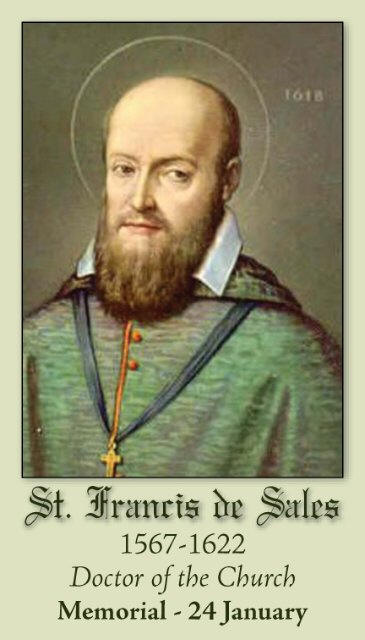
Jan 24 Saturday: St Francis De Sales, Bishop, Doctor of the Church. Mk 3:20-21
Today’s Gospel tells us how Jesus’ own relatives and fellow villagers, misunderstanding his mission, judged him to be out of his mind and tried to restrain him, hoping to take him back to Nazareth to resume the quiet, secure life of a village carpenter. Their reaction reveals a painful truth that Jesus himself later expressed when he said that a person’s enemies can sometimes be found within his own household. Yet Jesus did not respond with anger or resentment. With calm resolve and quiet obedience, he continued to carry out his Messianic mission, determined to fulfill the will of his Father rather than the expectations of others.
Several reasons may explain why Jesus’ family thought he had gone too far. First, he abandoned a stable and respected profession for a wandering life with no fixed home or guaranteed income. Like the prophets of old, especially Elijah and Jeremiah, Jesus chose obedience to God over personal security. Second, he surrounded himself with an unlikely group of followers, ordinary fishermen, a despised tax collector, and even a zealous nationalist. To human eyes, this looked reckless and imprudent. Third, Jesus openly challenged the religious elite of his time, the scribes, Pharisees, and chief priests, exposing their hypocrisy and misuse of authority. His relatives may have feared that such bold criticism would bring danger not only upon him but also upon them, as happened to prophets like Amos and John the Baptist. Fourth, Jesus spoke and acted with an authority that implied he was the long-awaited Messiah, confirming his words with miracles. Such claims were unsettling and dangerous in a society under Roman rule. Finally, his growing popularity may have stirred confusion, fear, and even jealousy among those who had known him simply as “the carpenter’s son.”
Life messages.
Throughout history, many saints were considered foolish or even insane because of their radical love for Christ. Like St. Paul, who spoke of being a “fool for Christ,” they remind us that true wisdom is found not in pleasing the world, but in faithful obedience to God.
Because Jesus himself experienced misunderstanding and rejection from those closest to him, he fully understands the pain we feel when we are judged or opposed by our own families. He stands with us and strengthens us in those moments.
We are called to respond with patience and forgiveness when people dismiss Christian faith as foolish or outdated. Like Jesus, we must stand firm with courage, trusting in the truth of his divine authority and the faithfulness of his promises.