


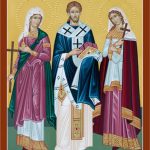


Sept 29 Monday: Saints Michael, Gabriel, and Raphael, archangels: Jn 1:47-51.
The Archangels: Michael, Gabriel, and Raphael
Angels are pure spirits created by God before the creation of humanity (Colossians 1:16). They exist as extensions of God’s love and providence, praising and worshiping Him (Isaiah 6:2-3), carrying His messages (Luke 1:19, 26), doing His will (Psalm 103:20-21), and guarding human beings. “He will give His angels charge over you, to guard you in all your ways” (Psalm 91:11).
Throughout Scripture angels appear not as mythical figures but as real ministers of God’s care. Two angels rescued Lot from Sodom (Genesis 19:1-16). God promised Moses, “My angel shall go before you” (Exodus 32:34). An angel strengthened Jesus during His agony in Gethsemane (Luke 22:43). The Acts of the Apostles records an angel liberating Peter from prison (Acts 12:7-11). Christian tradition, drawing on Scripture, recognizes nine “choirs” or orders of angels, among which the archangels stand out as God’s great messengers and protectors.
Michael – the Protector
Michael’s name means “Who is like God?” recalling the cry with which he opposed Lucifer’s rebellion. In Daniel he appears as “the great prince who stands guard over your people” (Daniel 12:1). In Revelation he leads the heavenly armies, defeating the dragon, “that ancient serpent…who is called the Devil” (Revelation 12:7-9). The Church invokes St. Michael in spiritual battle, echoing his biblical role as defender of God’s people.
Gabriel – the Messenger
Gabriel is best known for bearing God’s announcements. He foretold the birth of John the Baptist to Zechariah (Luke 1:11-20) and announced to Mary that she would conceive the Son of God (Luke 1:26-38). His greeting to Mary, “Hail, full of grace,” has become the heart of the Hail Mary prayer. In Daniel he also interprets visions about the Messiah (Daniel 8:16; 9:21). Gabriel embodies God’s desire to speak directly and tenderly to His people.
Raphael – the Guide and Healer
Raphael’s name means “God heals.” In the Book of Tobit he accompanies the young Tobiah on his journey, recovers family funds from Gabael, secures Tobiah’s marriage to Sarah, heals Tobit’s blindness, and drives away the demon tormenting Sarah (Tobit 3–12). Raphael shows how God appoints His angels to guide and heal us on life’s road.
Life messages
- A source of courage. The presence of angels gives us a real reason for hope in times of fear and uncertainty (Psalm 34:7).
- A call to holiness. Remembering that an angel watches over us is a strong incentive to do good and to avoid evil (Matthew 18:10).
- A motive for gratitude. Angelic protection and guidance are not to be taken for granted but gratefully acknowledged as part of God’s providence. God bless you.
Sept 30 Tuesday: Saint Jerome, priest and doctor of the Church. Lk 9:51-56
Jesus and the Samaritans – A Lesson in Patient Love
Today’s Gospel marks the beginning of Jesus’ final journey from Galilee to Jerusalem. Instead of taking the long route east of the Jordan, as most Jews did to avoid Samaria, Jesus deliberately travels through Samaria. This choice brings Him face to face with an old wound between two peoples.
The Samaritans were descended from Israelites who had intermarried with Assyrian settlers during the Assyrian exile of 721 BC (2 Kings 17:24). They blended the worship of the God of Israel with pagan practices. When the Jews returned from Babylonian exile (598–538 BC) and rebuilt the Temple (520–515 BC), they refused Samaritan help. In response the Samaritans built their own temple on Mount Gerizim (cf. John 4:20). This centuries-old hostility meant Jews would not even share utensils with Samaritans (John 4:9).
Because of this history, the Samaritans in today’s passage refuse hospitality to Jesus and His disciples. James and John, recalling Elijah calling down fire on hostile messengers (2 Kings 1:9-12), ask if they too should destroy these people. But Jesus “turned and rebuked them” (Luke 9:55). He is not a destroyer but a Savior (John 3:17). In the same Gospel He will later tell the parable of the Good Samaritan to show how mercy overcomes prejudice (Luke 10:25-37).
Jesus’ rebuke teaches that prejudices are healed not by force but by patient love, not by punishment but by mercy. “The anger of man does not produce the righteousness of God” (James 1:20). By taking the road through Samaria, Jesus shows us that the road of discipleship always passes through forgiveness, reconciliation, and courage to face long-standing barriers.
Life message
Today’s Gospel invites us to cultivate brotherly, patient, love, the ability to “bear with one another” (Colossians 3:13). Quick anger over small incidents can flare up in homes, workplaces, or parishes, often exploding over nothing. The Spirit of Jesus is opposed to such reactions. We can echo the psalmist’s prayer as our own: “Create in me a clean heart, O God, and put a new and right spirit within me…restore to me the joy of your salvation” (Psalm 51:10-12). God bless you.
Oct 1 Wednesday: Saint Theresa of the Child Jesus, virgin. Lk 9:57-62
The Cost of Discipleship
Today’s Gospel explains the cost of Christian discipleship and the wholehearted constancy, commitment, and sacrificial ministry that following Christ requires.
The requests and the challenge
A would-be follower tells Jesus, “I will follow you wherever you go!” But Jesus makes no false promises. “Foxes have holes, and birds of the air have nests, but the Son of Man has nowhere to lay his head” (Luke 9:58). Being a Christian is not an easy or comfortable affair. It calls for detachment, self-denial, self-control, and putting God before everything else. No earthly gain is to be expected.
The second man, whom Jesus Himself invited, asked to be allowed “first to bury my father.” In Semitic idiom, this did not mean the father had died but that the son wanted to remain at home until his father’s death. Jesus knew that if he postponed his response now, he would find other reasons later. Hence the striking words, “Let the dead bury their dead” (Luke 9:60). Christ’s call is unconditional, just as His love is unconditional. St. John Chrysostom explains, “It was not to have us neglect the honor due to our parents, but to make us realize that nothing is more important than the things of Heaven” (Homily on Matthew 27).
The third volunteer wanted to “say farewell to those at my home.” Jesus replies, “No one who puts his hand to the plow and looks back is fit for the Kingdom of God” (Luke 9:62). Unlike Elijah allowing Elisha to say goodbye (1 Kings 19:19-21), Jesus is inaugurating the definitive Kingdom. He demands exclusive service and a readiness to place family commitments in second place to the call of God.
Life messages
- We need to honor our commitments. In every age, but especially today, people enter into commitments, marriage, priesthood, religious life, public service without counting the cost, and later abandon them. The shortage of priests and religious witnesses is one sign of a culture afraid to make lifelong commitments. The Gospel challenges us to courageously live the promises we have already made.
- We need to pray for strength to keep those commitments. Each of us, in some way, has already said to Jesus, “I will follow you.” Sometimes we are faithful, at other times we fall short. The remedy is honest repentance, prayer for strength, and renewal of our determination. We show our fidelity to Christ by loyalty to our spouse and family, honest work, and living not only peacefully but lovingly with our neighbors (cf. Colossians 3:12-14). God bless you.
Oct 2 Thursday: The Holy Guardian Angel. Mt 18:1-5, 10.
The Guardian Angel
Although belief in a personal Guardian Angel is not formally defined as a dogma, it is deeply rooted in Sacred Scripture and Tradition. Every person’s Guardian Angel is a concrete sign of God’s faithful love and providential care for us day by day. The prayers of the Church in the Liturgy of the Hours and the Roman Missal describe three principal missions of the holy angels: (a) they ceaselessly praise and adore God, (b) they act as His messengers to humanity, and (c) they watch over and protect human beings.
A brief history of the devotion
Early monastic communities cultivated devotion to the angels, drawing strength from their intercession. St Benedict taught his monks to live as if under an angel’s constant gaze, and St Bernard of Clairvaux in the 12th century preached widely on the closeness of the Guardian Angel, shaping the devotion as we know it today. The feast of the Guardian Angels first appeared in local calendars in the 1500s and was inserted into the universal calendar by Pope Paul V in 1607. As the Roman Catechism of St Pius V explains, “By God’s providence angels have been entrusted with the office of guarding the human race and of accompanying every human being so as to preserve him from serious dangers… Our heavenly Father has placed over each of us an angel under whose protection and vigilance we are” (IV, 9, 4).
Biblical foundations
Jesus Himself alludes to personal angels for children when He warns, “See that you do not despise one of these little ones; for I tell you that in heaven their angels always behold the face of my Father who is in heaven” (Matthew 18:10). The Psalms echo the same promise: “He will give his angels charge of you, to guard you in all your ways” (Psalm 91:11). Throughout Scripture, angels guide and protect God’s people: the angel who led Israel through the wilderness (Exodus 23:20), the angel who delivered Peter from prison (Acts 12:7–10), and the angel who strengthened Jesus in Gethsemane (Luke 22:43). These examples show that angelic care is woven into salvation history.
Life messages
- Courage in place of fear. The belief that each of us is under the care of an angel is a source of confidence against baseless fears and anxieties (cf. Isaiah 41:10).
- A call to holiness. Remembering that a messenger from God witnesses our thoughts, words, and deeds inspires us to live holy lives, do good for others, and resist evil.
- Daily gratitude. We should thank God each day for His loving care expressed through the ministry of our Guardian Angel, and ask the angel’s help to stay on the path to heaven. God bless you.
Oct 3 Friday: Blessed Francis Xavier. Lk 10:13-16
Jesus’ Rebuke of Unrepentant Cities
In today’s Gospel Jesus issues a sobering warning to three towns, including Capernaum, which had become His base of ministry. Although they had witnessed His preaching and countless signs of God’s power, they had not allowed His words to take root or transform their lives. They failed to live up to the responsibility that comes with such grace.
Chorazin and Bethsaida
The Gospels give no specific list of miracles performed in Chorazin and Bethsaida, yet both towns clearly benefited from Jesus’ presence. Bethsaida, a fishing village on the northern edge of the Sea of Galilee, was the home of several apostles (John 1:44). Chorazin lay about an hour’s walk north of Capernaum. In heartfelt lament, Jesus expresses both righteous anger and deep sorrow at their cold indifference. He warns that on the Day of Judgment it will be more bearable for Tyre and Sidon—pagan cities notorious for idolatry (cf. Ezekiel 28:1–10)—than for these privileged towns. Those Gentile cities had never been given the same chance to hear the Gospel or to see His works (cf. Matthew 11:20–24).
This warning echoes the Old Testament prophets who grieved over Israel’s hardness of heart despite God’s repeated calls to repentance (Isaiah 1:2–4; Amos 3:2). Jesus stands in that prophetic line, His heart “broken” not for lack of power but for their refusal of mercy (cf. Luke 19:41–44, His tears over Jerusalem).
Life messages: Privilege brings responsibility
- The gift of Scripture. We are blessed to own Bibles and hear Scripture proclaimed at every Mass. We have a duty to read, pray with, and live God’s Word (cf. James 1:22).
- The daily Eucharist. Because we can attend the Sacrifice of the Mass frequently, we are called to participate devoutly and allow the Eucharist to transform our lives (cf. John 6:51–58).
- The Sacrament of Reconciliation. God’s mercy is freely offered; our responsibility is to seek it, be reconciled, and strive to amend our lives (cf. 2 Corinthians 5:18–20).
- Guidance of the Holy Spirit. We are not left alone; the Spirit leads the Church into all truth (John 16:13). We are therefore obliged to learn, embrace, and live the Church’s teaching.
- Mary and the Saints. God has given us a “great cloud of witnesses” (Hebrews 12:1). We must follow Christ by imitating their faith, courage, and charity.
In short, the privileges of grace demand a response of conversion. Like the people of Chorazin, Bethsaida, and Capernaum, we too are invited to let Jesus’ presence among us bear fruit. God bless you.
Oct 4 Saturday: Saint Francis of Assisi. Lk 10:17-24.
St. Francis of Assisi (1182-1226)
Giovanni Francesco Bernardone, later known as St. Francis of Assisi, is one of the most beloved saints of the thirteenth century. Born in Assisi, Italy, to Pietro Bernardone, a prosperous cloth merchant, Francis grew up enjoying comfort and the pleasures of youth—songs, feasts, and the admiration of his friends. Like many young men of his time, he joined a local militia in a city-state skirmish. Captured and imprisoned for a year, he returned home ill and inwardly changed. His conversion began when he embraced a leper in an act of humility and compassion, echoing Christ’s call to touch the untouchable (cf. Matthew 8:2-3).
Praying in the dilapidated chapel of San Damiano, Francis heard a voice: “Francis, rebuild my Church, for it is falling into ruin.” Taking the command literally, he sold some of his father’s cloth to finance repairs. When his father angrily disowned him, Francis renounced his inheritance publicly, returning even his clothes and keeping only a rough tunic. He began living as a beggar and itinerant preacher, following Jesus’ instruction to the rich young man, “Go, sell what you have, and give to the poor… then come, follow Me” (Mark 10:21).
A handful of young men soon joined him in this radical way of life. Around the same time, Pope Innocent III had a dream of a small man in a poor habit holding up the walls of the Lateran Basilica—the Pope’s own cathedral and the symbol of the universal Church. Recognizing Francis as the man in his vision, the Pope granted approval for a new community. Thus began the Order of Friars Minor (the “Lesser Brothers”), embracing poverty, chastity, and obedience, and practicing a fourth hallmark—charity—as a way of living the Gospel in its simplicity.
The Franciscans quickly spread throughout Italy and beyond, preaching repentance and drawing hearts back to Christ. Francis sent missionaries to other European lands, always emphasizing trust in God’s providence and service to the poor. Like the apostles sent out two by two (Luke 9:1-6), the friars owned nothing and gave away any surplus. When later leaders modified his original Rule, Francis withdrew from active leadership, retreating to the mountains for prayer and solitude. There he received the stigmata, the wounds of Christ—on September 14, 1224, a visible sharing in the sufferings of the Crucified (cf. Galatians 6:17).
During his final years, plagued by illness and near-blindness, Francis composed the “Canticle of Brother Sun,” a hymn of praise for creation. Even when he could no longer see the world’s beauty, his soul overflowed with gratitude for “brother fire,” “sister water,” and all God’s creatures, echoing Psalm 148’s call for every element of creation to praise the Lord. Tradition recalls him preaching even to birds and exhorting animals and people alike to honor their Creator.
Francis died at the little chapel of the Portiuncula on October 4, 1226, at age 44, and was canonized within two years. His entire life was a living commentary on the Gospel: poverty, humility, and joyful praise of God’s creation.
Life messages:
Let us proclaim Christ’s love and mercy as Francis did, not only in words but through transparent Christian living, reverence for creation, and visible joy in God’s gifts (Matthew 5:16).
Like Francis, let us practice detachment so that sinful attachments, addictions, and harmful habits lose their hold and we become free for God (cf. Philippians 3:8).
Poverty embraced for the Kingdom makes our goods available for all, reminding us that possessions are entrusted to us for sharing, not hoarding (Acts 4:32-35). God bless you.

![ORDINARY TIME XXVI [yr. C] (Sept. 28).Am 6:1a, 4-7; 1Tm 6:11-16; Lk 16:19-31. (By: Rev. Fr. Clifford Atta Anim)](https://frcliffordhomilies.com/wp-content/uploads/2025/09/IMG_1486-150x150.jpeg)
