




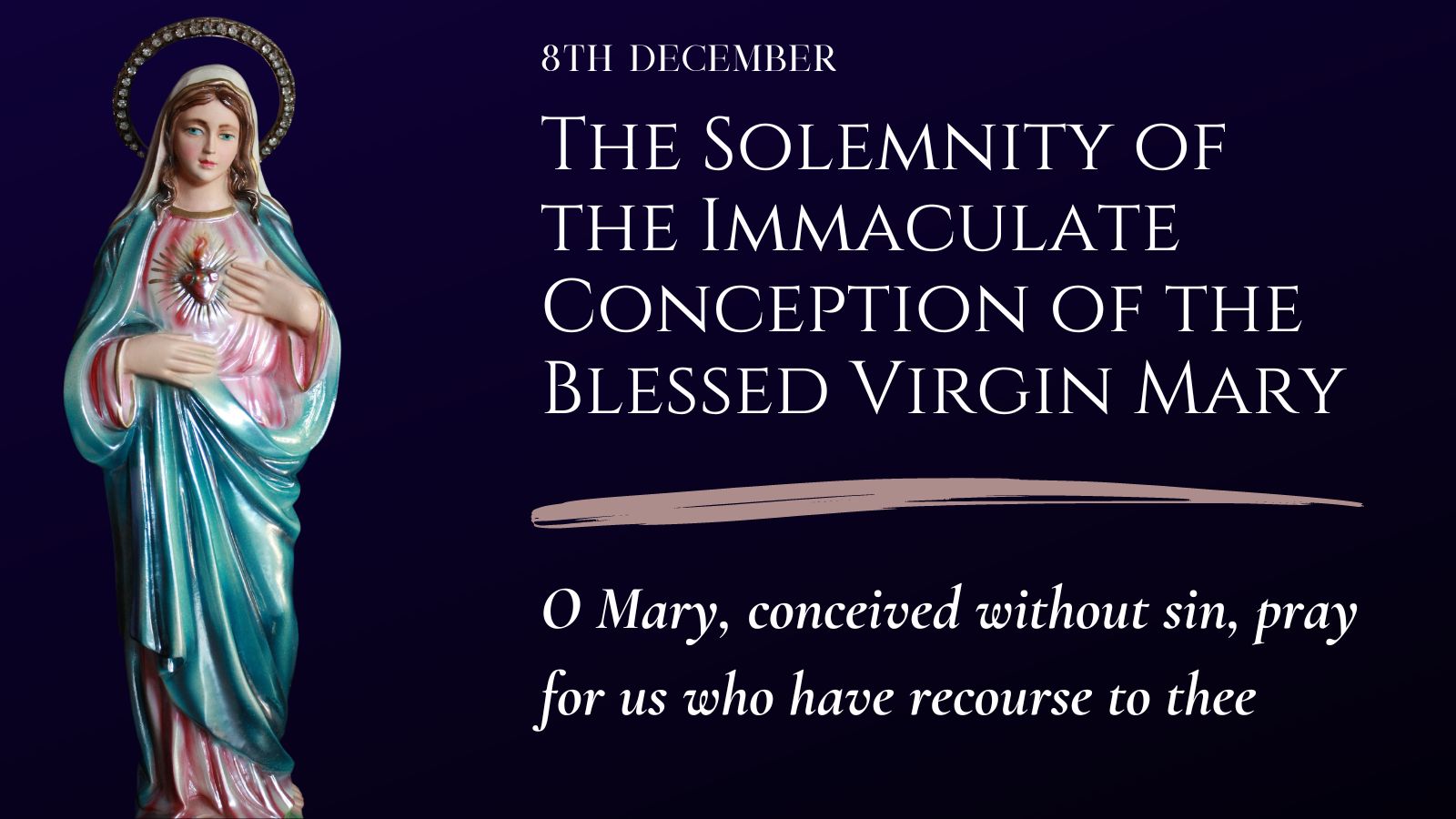
Dec 8 Monday: Feast of Immaculate Conception of BVM. Lk 1:26-38
The Immaculate Conception stands on a long and trusted Christian inheritance. By the late seventh century, monks in the monasteries of Palestine were already keeping a feast that honored the beginning of Mary’s life. Over the next few centuries the celebration made its way across the Christian world, taking root in Italy by the ninth century, in England by the eleventh century, and in France by the twelfth century. Pope Leo VI encouraged its observance, and Pope Sixtus IV later confirmed it as a liturgical feast. The Church finally gave formal expression to what believers had held in their hearts for centuries when Pope Pius IX proclaimed the dogma of the Immaculate Conception in 1854. Four years later, Mary confirmed this truth at Lourdes when she identified herself to Bernadette with the words, “I am the Immaculate Conception.”
Scripture gives us the foundations that help us recognize the wisdom of this belief. First, we see that God sanctifies His servants even before their birth. The prophet Jeremiah was set apart in his mother’s womb, showing that divine grace can reach a person at the very beginning of life. John the Baptist experienced this same grace when he leapt with joy in Elizabeth’s womb at the sound of Mary’s greeting, a moment that reveals the Holy Spirit already at work in him. If God grants such gifts to His prophets, it is fitting that the woman chosen to carry His Son would receive an even greater grace from the first instant of her existence.
We also hear the angel call Mary “full of grace,” a greeting that points to a life untouched by sin, a life already filled with God’s favor. In the Book of Genesis, God promises that the woman and her offspring would stand in total opposition to the serpent. This complete enmity makes sense only if the woman, Mary, was never under the power of sin the serpent brought into the world. Other biblical moments echo this harmony, such as the ark of the covenant, a vessel made pure and precious because it carried the presence of God. Mary, the new ark who bore the Word made flesh, fittingly reflects that same holiness.
Reason also supports this mystery. If any of us could choose our mother, we would choose someone noble and virtuous. God did what was right and fitting by preparing a mother worthy of His Son. As Blessed Duns Scotus expressed it, God could do it, it was appropriate, so He did it.
This feast leaves us with simple and encouraging lessons. A good mother wants her children to follow her good example, and our holy Mother desires our hearts to grow in purity and goodness. We honor her not only with words but by imitating her trust in God and her willingness to say yes. And as she cooperated fully with the grace she received, we can respond to God’s grace by choosing what is good and lifting others up. God bless you.
References and Sources
Catechism of the Catholic Church, sections 490 to 493
Pius IX, Ineffabilis Deus (1854)
St. Luke’s Gospel, chapters 1 and 2, Genesis 3:15, Jeremiah 1:5
Dec 9 Tuesday: St. Juan Diego Cuauhtlatoatzin. Mt 18:2-14
The Pharisees who questioned Jesus could not bring themselves to imagine that God rejoices when a sinner turns back to Him. Their hearts were convinced that holiness meant separation rather than mercy. In response, Jesus offered three parables that gently corrected their narrow vision, each one revealing the joy of God when someone who is lost finds the courage to return home. He spoke of the shepherd who leaves the ninety nine to look for the stray, the woman who searches every corner of her house until she finds her missing coin, and the father who runs to embrace his wayward son the moment he appears on the road. All three stories defend Jesus’ closeness to sinners and answer the criticism that He welcomed tax collectors and broken people. The Gospel’s main message is simple and life giving: God is patient, God is merciful, and God delights in forgiving those who return to Him with sincere hearts and a desire to begin again.
The image of a shepherd would have made deep sense to His listeners. Shepherding in Judea was demanding and risky. Grass was scarce, rocky ravines were common, and predators roamed the hillsides. A shepherd needed constant alertness and a willingness to risk his life for the flock, which is why the people admired their dedication. Often two or three shepherds shared responsibility for the village’s sheep, and if even one animal went missing, one shepherd would set out at once to search while the others returned home with the flock. The whole village waited anxiously, and when the shepherd finally appeared with the lost sheep draped across his shoulders, the people celebrated the recovery with genuine joy. That is the picture Jesus uses for the Father’s heart, a God who does not abandon, who does not rest, who goes out looking for His children even when they wander far.
Jesus Himself later described this mission in similar words, saying that the Son of Man came to seek and save the lost. Scripture gives further examples of this divine tenderness. God looked for Adam and Eve when they hid in the garden. He called Israel back through the prophets again and again. Jesus forgave Peter after his denial and brought him back into mission with the simple invitation, follow me. These moments echo the same truth that God’s joy is not found in condemning but in rescuing.
Life messages.
First, we regain peace and friendship with God when we admit our need for His mercy. Confession is not a place of fear, it is the moment we place ourselves on the shoulders of the Good Shepherd. When we have strayed, God is ready to receive us, just as Jesus welcomed those who felt far from grace. We can ask today for the humility to let His forgiveness heal us.
Second, the mercy we receive should shape how we treat those who have hurt us. God’s grace gives us the courage to forgive and to pray for those who have drifted away. As we continue the Mass, we can intercede for those whose faith has grown cold, trusting that God is already searching for them and longing to bring them home. God bless you.
References and Sources
Luke 15:1 to 32, Luke 19:10, Genesis 3:8 to 9, Psalm 23, Ezekiel 34, John 21:15 to 19
Catechism of the Catholic Church, sections 1422 to 1470
Pope Francis, Misericordiae Vultus
St Augustine, Sermons on Luke 15
Dec 10 Wednesday: Our Lady of Loretto. Mt 11:28-30
In the Gospel today, Jesus speaks directly to the weary of heart, promising rest to anyone who carries heavy burdens and is willing to accept His “easy yoke” and “light burden.” For many faithful Jews of His time, religion felt more like weight than freedom. They lived under the demands of hundreds of written laws and countless oral rules that shaped every detail of life. Into that world Jesus offers a different path. He invites Israel, and each one of us, to place His yoke across our shoulders. In ancient Palestine, a yoke was carefully shaped from wood so it would fit an ox comfortably. That image helps us understand that the yoke Jesus gives is not meant to wound or restrict. It represents our responsibilities as His followers, yet it is shaped with love and fitted to our strength.
At the heart of this yoke is one command: love one another as I have loved you. His yoke is light because it is carried in relationship, not isolation. It is not only a yoke from Him but a yoke with Him. We are not pulling the plow alone, straining with our own limited strength. Christ is beside us, carrying the weight with us, sharing His power and His peace. He invites us to let our will move with His will and our heart beat with His heart. When He says His yoke is easy, He means God’s demands are never mismatched to our ability. What He asks of us fits who we are, and He never sends grace without the strength to respond.
Jesus then adds, “My burden is light.” He does not claim that discipleship is effortless. He is telling us that whatever He asks of us is given in love and meant to be carried in love. Love changes the weight of things. A task that feels crushing when done alone becomes bearable, even joyful, when borne with someone we trust. To follow Jesus is to discover a kind of peace the world cannot give, a rest that reaches deeper than sleep and settles the soul.
We all know the burdens that press on us: responsibilities, financial worries, family struggles, declining health, fear of the future, wounds from the past, and the thousand anxieties that fill our days. Jesus asks us to hand these to Him, to exchange our restless burdens for His steady presence. When He says, “Take my yoke and you will find rest,” He is inviting us to live the Christian life with God at the center. When we walk in His commandments and trust His guidance, the weight we carry becomes lighter.
Life messages.
First, we need to let go of burdens that drain our strength. Jesus wants to lift the weight that exhausts us so He can place on us His life giving yoke, one that brings renewal, peace, and new energy for the people around us.
Second, we need to bring our burdens before the Lord. Worship gives us a place to slow down and breathe again. When we come before God, especially when we confess our sins and leave behind the weight of guilt, we let our overheated hearts cool in His presence. At the altar we can place everything that troubles us into His hands and rise with lighter hearts. God bless you.
References and Sources
Matthew 11:25 to 30, John 13:34, Psalm 55:22, 1 Peter 5:7, Deuteronomy 30:11 to 14, Jeremiah 6:16
Catechism of the Catholic Church, sections 608, 1822 to 1829
St Augustine, Sermons on Matthew
St John Chrysostom, Homilies on Matthew 11
Dec 11 Thursday: St. Damasus I, Pope. Mt 11:1-15
John the Baptist had spent his ministry preparing Israel for a Messiah who would come with fire, judgment, and power. Yet from prison he began hearing reports that Jesus was gentle with sinners, patient with the broken, and willing to sit at table with tax collectors. This did not match the stern image John had preached, so he sent some of his disciples to ask Jesus directly whether He truly was the One Israel had been waiting for. Jesus responded not with theories but with signs. He told them to report what they had seen, the blind receiving sight, the lame walking, lepers cleansed, the deaf hearing, the dead raised, and the poor receiving good news. These were the very works the prophets had said the Messiah would do. Once John’s messengers left, Jesus spoke with great admiration about him.
Jesus praised John first as a prophet, someone whose mind held God’s wisdom, whose voice carried God’s truth, and whose heart burned with God’s courage. John had spoken with clarity and fearlessness, calling Israel to repentance and preparing the way for the Lord. Jesus also called him the Elijah who was to come, the figure expected to appear before the Messiah arrived. Like Elijah, John lived simply, confronted injustice, and stood firm before powerful rulers. Crowds streamed into the wilderness to listen to him and to receive his baptism of repentance.
Yet Jesus made a surprising point. As great as John was, those who follow Christ share an even greater privilege. John announced judgment and the need for conversion, but he did not live to see the fullness of Christ’s saving love on the cross or the victory of the resurrection. We live on the other side of that story, knowing the complete truth of God’s mercy and the hope given to the world through Jesus. Still, Jesus warned His followers that choosing the Kingdom would not be easy. Faithfulness attracts resistance, and entering the Kingdom requires pushing back firmly against our selfish instincts, our pride, and the forces that pull us away from God.
Life message.
We are called to hold the same courage John displayed. In a world that often prefers silence or compromise, we need the strength to stand by what we believe and to live what the Church teaches with integrity and joy. God bless you.
References and Sources
Matthew 11:2 to 15, Isaiah 35:5 to 6, Isaiah 61:1, Malachi 3:1, 4:5, Luke 1:15 to 17, John 1:19 to 34
Catechism of the Catholic Church, sections 523 to 524
St Augustine, Sermons on John the Baptist
St John Chrysostom, Homilies on Matthew 11
Dec 12 Friday. Lk 1:26-38
Today we hear the Lord’s sorrowful question, “To what shall I compare this generation?” This complaint reflects a heartbroken amazement at our refusal to be satisfied with God or grateful for His gifts. We often meet Him with restlessness, murmuring, and blame, even when His presence is meant to heal us. Jesus sees a people who resist His call, who remain hardened, who are unmoved whether He plays a joyful song or offers a call to conversion.
Yet He reminds us that “wisdom is vindicated by her works.” If we want proof of God’s faithfulness, we need only look toward the mystery we prepare to celebrate at Christmas. The Incarnation itself is God’s testimony. But His words raise a hard question: what about our response? Is our constant complaining hiding a deeper unwillingness to answer God? Advent is the right moment to ask this honestly.
God draws near again and again, but humanity often slips away. Some run from Him out of fear, like Herod who trembled at the thought of a newborn King. Others reject Him outright, as the crowd later shouted in John’s Gospel, “Take him away, crucify him.” Pope Benedict XVI once said that Jesus is “the God who comes,” yet we behave like “the people who walk away.” John expresses the sadness of this truth: “He came to His own, and His own did not receive Him.”
Why do we flee? Most often because our hearts are not gentle. John the Baptist urged us to decrease so that Christ might increase, and the season of Advent repeats that same invitation. A proud heart cannot recognize a humble Savior. We must become small enough to welcome the Child of Bethlehem, the God who appears not in power but in poverty. No one had ever imagined God wrapped in swaddling clothes, depending on human arms for warmth. When we hide behind excuses or justifications, we look as foolish as Adam blaming Eve and Eve blaming the serpent. So many generations have passed, yet we still resist admitting our need.
But look at how God answers our fear. When He comes, He comes without threats. In the cold and simplicity of Bethlehem, He offers no reproach. Instead, He begins carrying the weight of our sins on shoulders still too small for the task. How could we fear a God who meets us like this? How could excuses stand before such tenderness? Benedict XVI once wrote that God’s sign is the Child, and from Him we learn that true love always includes humility, self-giving, and quiet surrender. God bless you.
References and Sources
Matthew 11:16 to 19, John 1:11, John 19:15, Luke 1:17, Philippians 2:6 to 8, Genesis 3:8 to 13
Pope Benedict XVI, Jesus of Nazareth: The Infancy Narratives
St Augustine, Sermons for Advent
Dec 13 Saturday: St. Lucy, Virgin, Martyr. Mt 17:9-13
Today’s Gospel presents the sober instruction Jesus gave to Peter, James, and John as they descended the mountain after the Transfiguration. The disciples had just seen His glory unveiled, yet Jesus immediately told them to keep silent about the vision. He knew the crowds were expecting a political liberator, a Messiah who would overthrow Rome, restore Israel’s power, and arrive with Elijah as His fiery herald. If the people heard about the dazzling light on the mountain, they would cling even more tightly to that misunderstanding.
Jesus then guided His disciples toward the truth of His identity. He revealed that He Himself was the long-awaited Messiah, but not in the way Israel expected. He also taught that John the Baptist had already fulfilled the role of Elijah for those willing to see it. Scripture had foretold that Elijah would come before the Day of the Lord. The scribes assumed this meant Elijah would precede the Messiah’s first arrival, but they misread the plan. Jesus explained that John came in the “spirit and power of Elijah,” preparing hearts for the Messiah’s first coming through his call to repentance. Elijah himself will return only at the final coming of Christ, when the Lord gathers His people at the end of the age.
Jesus wanted His disciples to grasp that His mission would not unfold through political strength or military triumph. The Messiah’s path would run through suffering, rejection, and death, a truth the Transfiguration prepared them to face. His glory on the mountain was real, but the way to that glory would be the cross. John’s ministry had helped Israel recognize this new kind of Messiah, one who conquers not by force but by self-giving love.
Life message.
Let us welcome Jesus as Lord and Savior, the Messiah who redeemed us through His sacrifice on the cross. We cooperate with His saving work by living His command of love and following the guidance of the Church He founded. When we unite our own trials with His, God transforms our sufferings into something redemptive, drawing us closer to Him and blessing others through us. God bless you.
References and Sources
Matthew 17:1 to 13, Mark 9:2 to 13, Luke 1:16 to 17, Malachi 3:1, 4:5 to 6, Isaiah 53
Catechism of the Catholic Church, sections 555, 713, 718
St John Chrysostom, Homilies on Matthew 17
St Augustine, Sermons on the Transfiguration


https://shorturl.fm/7nf0E
God bless you soo much.
Amen