




Exodus 19:2-6a
Romans 5:6-11
Matthew 9:36-10:8
OVERVIEW OF THE READINGS
The Book of Exodus presents God’s covenant with Israel at Mount Sinai, where he declares the people to be a kingdom of priests and a holy nation. The Letter to the Romans proclaims that Christ died for sinners while they were still helpless, revealing the depth of God’s love and accomplishing their reconciliation with him. In the Gospel according to Matthew, Jesus is moved with compassion for the harassed and helpless crowds and commissions the Twelve to proclaim the Kingdom and to heal every disease. The thread uniting all three readings is God’s loving initiative, which calls a people into covenant, reconciles them through Christ, and sends them forth in mission.
REFLECTION
My dear People of God, the first reading brings us to the foot of Mount Sinai. The Israelites have recently been delivered from slavery in Egypt. They are no longer Pharaoh’s possession; they now belong to the Lord. Yet belonging to God is never an end in itself. It always entails a mission.
Through Moses, God declares: “You shall be my own possession among all peoples … you shall be to me a kingdom of priests and a holy nation.” The expression used in the original text denotes a treasured possession— something precious and specially reserved for a king. God does not choose Israel merely to keep her as a trophy; he chooses her for service. The entire nation is entrusted with a priestly vocation. Priests stand between God and his people; here, Israel is called to mediate God’s presence to the nations. Likewise, holiness does not primarily signify moral perfection but being set apart for God’s purposes. This vocation originated entirely from God’s gracious initiative. Israel did not earn it; she simply received it.
Consider a beggar sitting by the roadside each day with an empty bowl. A wealthy merchant notices his poverty and, without being asked, fills the bowl with gold coins. The beggar is overwhelmed with gratitude. Then the merchant says: “Now go and find others who are as needy as you were, and share with them whatyou have received.” Such was Israel’s experience. God first bestowed his gifts freely and then entrusted his people with the mission of sharing those gifts with the world.
The Fathers of the Church saw in Israel’s vocation a foreshadowing of the Church. Origen teaches that just as Israel was called to be a kingdom of priests, so too the Church inherits this mission as the new People of God (Homilies on Exodus, 2). Saint Augustine further observes that the image of the eagle’s wings symbolises Christ’s Ascension, through which he bears his Church to himself (Tractates on John, 11).
Dearly beloved, the second reading deepens our appreciation of God’s saving initiative. Saint Paul paints a sobering picture of humanity’s condition before Christ: weak, ungodly, sinful, and estranged from God. The underlying term translated as “weak”conveys the idea of being powerless—incapable of rescuing oneself. Humanity could not heal its own wounds or bridge the gulf created by sin. Humanly speaking, the situation appeared hopeless.
Against this backdrop, Paul makes one of the most astonishing declarations in the New Testament: “While we were still sinners, Christ died for us.” Not after we had reformed our lives. Not after we had become worthy of God’s favour. Rather, while we were still living in rebellion against him. Here we touch the very heart of the Gospel. God does not wait for us to make the first move. He comes to us in our weakness, our brokenness, and our need. Paul argues from the lesser to the greater: if Christ was willing to die for us while we were enemies, how much more will he save us now that we have been reconciled to God? The original term for “reconciliation” denotes a transformation from hostility to friendship—the healing of a fractured relationship. Salvation is therefore not merely a legal acquittal; it is the restoration of communion with God (cf. Origen, Commentary on Romans, 5).
Imagine a father whose son abandoned the family home, squandered his inheritance, and eventually found himself imprisoned. Despite the pain and disappointment, the father visited him regularly, provided for his needs, and never ceased loving him. When the son was finally released, the father welcomed him home and entrusted him with responsibilities in the family business. The son had done nothing to merit such generosity. Everything flowed from the father’s love. In a similar way, God loved us before we loved him. Christ died for us while we were still far from him, and through that sacrifice we are restored to fellowship with God and entrusted with a share in his saving work.
Saint Augustine emphasises that Christ’s death for sinners reveals the primacy of divine grace rather than human merit (On the Spirit and the Letter, 33). Saint John Chrysostom marvels that while people occasionally sacrifice themselves for those whom they love, God allowed his Son to die for those who were actively opposed to him (Homilies on Romans, 7).
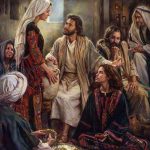
Brothers and sisters in Christ, the Gospel shows us the fruit of this divine initiative. Jesus looks upon the crowds and is deeply moved with compassion. The original expression suggests an emotion arising from the deepest part of one’s being. Jesus does not merely observe the people’s suffering; he enters into it. Their pain touches his heart.
Why is he moved? Because the crowds are “harassed and helpless, like sheep without a shepherd.” The biblical terms describe people who are worn out, burdened, scattered, and abandoned. They long for guidance yet struggle to find it. They seek hope but often encounter disappointment. Many had leaders who should have cared for them, yet those leaders frequently imposed burdens without offering genuine pastoral care. Faced with this situation, Jesus does not remain a passive observer. Compassion leads him to action.
He therefore tells his disciples: “The harvest is plentiful, but the labourers are few.” The image of the harvest points beyond agriculture to God’s saving work among his people. It evokes the gathering of men and women into the Kingdom. The difficulty is not a shortage of those whom God wishes to save; rather, it is the scarcity of labourers willing to cooperate in his mission. Saint Jerome interprets the harvest as the multitude of souls ready to receive the Gospel (Commentary on Matthew, 9).
Jesus then calls the Twelve and entrusts them with authority over unclean spirits and every kind of disease and infirmity. The original expression for “authority” signifies a delegated authority – a power received from another. The disciples are not acting in their own name or by virtue of their own abilities. They are acting in the name and by the authority of Christ. Their mission is first directed to “the lost sheep of the house of Israel,” but it already anticipates the universal mission that will follow after the Resurrection.
The Lord’s instructions are clear and practical: heal the sick, raise the dead, cleanse lepers, cast out demons. In other words, bring the healing and liberating power of God’s Kingdom wherever human suffering is found. Then Jesus adds a principle that remains fundamental to Christian discipleship: “Without cost you have received; without cost you are to give.” The term employed here means “freely, as a gift.” Everything the disciples possess has first been received from God. Therefore, they must become generous channels of that same grace to others.
Consider a woman who received life-saving treatment from a travelling physician who asked for no payment. Deeply grateful, she later encountered a neighbour suffering from the same illness. Remembering the kindness she had received, she brought her neighbour to the doctor. Soon she was helping other sick people to find their way to him. She did so not for reward or recognition, but because gratitude had transformed her life. This image captures the essence of Christian mission. We have received forgiveness, healing, hope, and new life as gifts. We are now called to help others to encounter the One from whom these gifts flow.
Saint John Chrysostom observes that Christ’s compassion was so great that he did not wait for people to seek him out; rather, he went in search of those who were suffering (Homilies on Matthew, 32). Saint Jerome sees the shortage of labourers as a challenge addressed to every generation of believers (Commentary on Matthew, 9).
THE REFLECTION IN A NUTSHELL
The readings of today remind us that God is always the one who takes the first step. At Sinai, he chose Israel as his treasured possession and called them to be a priestly people among the nations. Through Christ, he reconciled humanity to himself while we were still powerless and estranged from him. In the Gospel, Jesus looks upon the weary and scattered crowds with compassion and sends labourers into his abundant harvest. God calls, God reconciles, and God sends. That same pattern continues in the life of the Church today. We have received grace freely and undeservedly; therefore, we are called to share it generously. Our mission flows not merely from duty but from gratitude—not merely from obligation but from the joy of having been sought, found, and loved by God.
May we therefore go forth as labourers in the Lord’s harvest, carrying to others the grace we ourselves have freely received, and bearing witness to the love that first called us, redeemed us, and sent us forth.


![Ordinary Time Week XI [Yr. A] (June 14, 2026) Ex 19:2-6; Rom 5:6-11; Mt 9:36–10:8. By: Rev. Fr. Clifford Atta Anim.](https://frcliffordhomilies.com/wp-content/uploads/2026/06/IMG_3267-150x150.jpeg)