


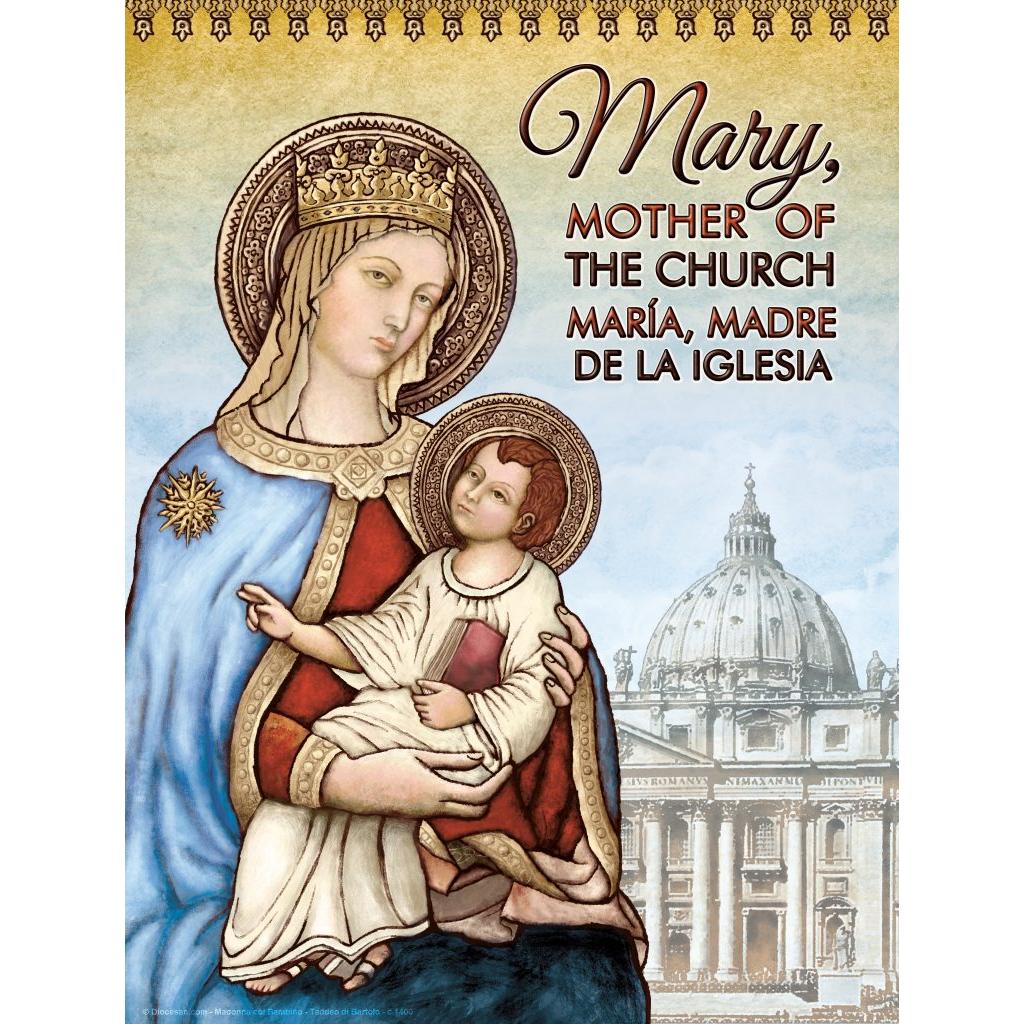
May 25 Monday: Blessed Virgin Mary, Mother of the Church: Jn 19: 25-34
of the notable architectural additions to Saint Peter’s Square is the beautiful mosaic of Mary, “Mother of the Church,” accompanied by the inscription Totus Tuus, the Marian motto closely associated with Pope John Paul II and his profound devotion to the Blessed Virgin Mary. This title, “Mother of the Church,” has gained renewed prominence in recent years, especially after Pope Francis decreed on March 3, 2018, that the Monday after Pentecost should henceforth be celebrated throughout the universal Church as the Memorial of the Blessed Virgin Mary, Mother of the Church. This memorial was officially inserted into the General Roman Calendar, the Roman Missal, and the Liturgy of the Hours to encourage Marian devotion and deepen the Church’s awareness of Mary’s maternal role in the life of believers.
The choice of the Monday after Pentecost is deeply significant. Pentecost marks the birth of the Church through the outpouring of the Holy Spirit upon the apostles gathered in prayer with Mary in the Upper Room (Acts 1:14; 2:1–4). Since Mary is the Mother of Christ, the Head of the Church, she is rightly honored also as Mother of the Church, the Mystical Body of Christ. Her spiritual motherhood extends to all who belong to Christ. At Calvary, Jesus entrusted His mother to the beloved disciple with the words, “Behold your mother” (John 19:27). The Church has always understood this moment not merely as a personal arrangement for John, but as Christ’s gift of Mary to all believers.
The title “Mother of the Church” has ancient roots in Christian tradition. It was used as early as the fourth century by Saint Ambrose and later appeared in the teachings of various popes, including Pope Leo XIII. However, the title received solemn emphasis during the closing of the third session of the Second Vatican Council on November 21, 1964, when Pope Paul VI officially proclaimed Mary “Mother of the Church,” declaring her the Mother of the whole People of God, both faithful and pastors alike.
The teaching was later deepened by Pope John Paul II in his encyclical Redemptoris Mater (1987), where he reflected on Mary’s spiritual motherhood flowing from the Cross and continuing within the Church. He explained that Mary, in her motherhood in the Spirit, embraces every believer and accompanies the Church throughout history. The Catechism of the Catholic Church echoes this teaching, stating: “Mary joined in bringing about the birth of believers in the Church, who are members of its Head” (CCC 963). The Catechism also beautifully describes her as both virgin and mother, the perfect image and realization of the Church herself (CCC 507).
Pope Benedict XVI further reflected on the close connection between Mariology and ecclesiology, drawing from the insights of theologian Hugo Rahner. Just as Mary is virgin and mother, holy yet present within human history, so too the Church carries both divine holiness and human weakness while journeying toward heavenly glory. Mary therefore becomes the living icon of what the Church is called to be: faithful, holy, obedient, suffering, and ultimately glorified.
The decree establishing the memorial was signed on February 11, 2018, the memorial of Our Lady of Lourdes, marking the 160th anniversary of the Lourdes apparitions, and officially promulgated on March 3, 2018. This connection highlights Mary’s continuing maternal care for the Church throughout history.
The saints consistently recognized that Mary’s greatness lies not only in her divine motherhood, but also in her faith and obedience. Saint Augustine of Hippo famously observed that Mary is more blessed because she believed in Christ than because she physically bore Him. Likewise, Saint Ambrose taught that Mary is the model of the Church in faith, charity, and perfect union with Christ. Her life demonstrates complete surrender to God’s will, beginning with her “yes” at the Annunciation: “Be it done unto me according to your word” (Luke 1:38).
Mary therefore remains the supreme model for every Christian disciple. As Mother of God, the Theotokos, and Mother of the Church, she teaches believers how to trust, obey, and persevere in faith. Her humility, purity, silence, prayerfulness, and unwavering fidelity at the foot of the Cross continue to inspire the Church in every age.
As Cardinal Robert Sarah once beautifully stated, “The Cross, the Eucharist, and the Mother of God are three mysteries that God gave to the world in order to structure, fructify, and sanctify our interior life and lead us to Jesus.” May we honor Mary, Mother of the Church, not only with words and devotions, but above all by imitating her virtues of faith, humility, obedience, purity, and total surrender to the will of God. God bless you.
May 26 Tuesday: Mk 10:28-31
Today’s Gospel reminds us that Christ continues to call people to follow Him, just as the landowner in the parable went out repeatedly to invite laborers into his vineyard. God’s call is universal. He seeks disciples, friends, witnesses, and co-workers in His Kingdom. No one is excluded from this invitation. Whether early or late in life, each person is called to enter the vineyard of the Lord and participate in His saving work.
Yet discipleship comes with a demanding condition. Jesus tells His followers that for His sake and for the sake of the Gospel they must be ready to leave behind whatever prevents them from belonging fully to Him, even family ties, possessions, comfort, or personal security (cf. Mark 10:29). This does not mean rejecting family responsibilities or despising earthly blessings. Rather, it means placing Christ above everything else and allowing no attachment to take priority over God. The call to discipleship is therefore radical because it asks for total surrender and complete trust.
Peter, speaking on behalf of the apostles, reminds Jesus that they have left everything to follow Him, almost as if asking what reward they will receive. Jesus responds with extraordinary generosity. He promises that whoever sacrifices for the Kingdom will receive “a hundredfold now in this present age” and eternal life in the age to come (cf. Mark 10:30). God can never be outdone in generosity. Every sacrifice offered for Christ opens the heart to deeper spiritual blessings, new relationships in the family of faith, and ultimately eternal communion with God.
At the same time, Jesus adds an important realism to His promise: “with persecutions.” Following Christ is not a path free from suffering. True discipleship often brings misunderstanding, rejection, sacrifice, and hardship. Jesus does not deceive His followers with false promises of an easy life. Instead, He teaches that suffering endured for His sake becomes spiritually fruitful. Trials purify faith, strengthen character, deepen trust in God, and unite believers more closely to Christ crucified. Every sacrifice accepted with love makes the disciple more like Jesus, who redeemed the world through the Cross.
This Gospel therefore invites us to examine our own lives. There is always time to draw closer to Christ, especially during sacred seasons such as Advent and Lent, but truly in every moment of life. Through prayer, the Sacraments, and reflection on God’s Word, we can discern whether we are responding generously to the Lord’s call. Not everyone is called to leave everything in the literal way the apostles did, but every Christian is called to detach from whatever weakens friendship with Christ or hinders faithful discipleship.
For some, leaving things behind may mean overcoming pride, selfishness, unhealthy attachments, sinful habits, excessive ambition, or fear of public witness. The essential question is whether Christ truly occupies the center of our lives. The world urgently needs authentic witnesses who live the Gospel with courage, joy, and conviction. To follow Jesus wholeheartedly is not a loss, but the greatest gain, because in giving ourselves to Him, we discover the fullness of life and the joy that endures forever.
May 27 Wednesday: St. Augustine of Canterbury, Bishop. Mk 10:32-45
Mark’s Gospel (Mk 8:31; 9:31; 10:32), Jesus openly predicts His suffering, death, and Resurrection. Yet, despite hearing these prophecies repeatedly, James and John still fail to grasp the true nature of His mission. Like many Jews of their time, they expect the Messiah to be a powerful political ruler who would restore the kingdom of Israel, overthrow Roman oppression, and reign from the throne of David. Convinced that Jesus’ journey to Jerusalem will end in earthly victory, the two brothers approach Him seeking positions of honor and authority in what they imagine will be His political kingdom.
The request of James and John reveals a misunderstanding of leadership in the Kingdom of God. They see greatness in terms of status, privilege, and power. Jesus therefore challenges them with a serious question: “Can you drink the cup that I drink, or be baptized with the baptism with which I am baptized?” (Mark 10:38). In biblical language, the “cup” often symbolizes suffering and destiny, while “baptism” here refers to being overwhelmed by pain and sacrifice. Jesus is speaking about His coming Passion and Death. To reign with Christ means first to suffer with Him.
Without fully understanding the depth of Jesus’ words, James and John quickly answer that they are able to share His cup and baptism. Their response is sincere but immature. Only later would they come to understand the cost of true discipleship. Saint James the Greater eventually became the first of the apostles to die as a martyr, beheaded by Herod Agrippa (Acts 12:2). Saint John the Apostle endured years of suffering as he witnessed persecution within the Church, confronted false teachings, suffered exile, and outlived the other apostles, remaining faithful to Christ until old age. In different ways, both brothers eventually drank from the cup of suffering they had once accepted without understanding.
Jesus then teaches His disciples the true meaning of greatness. Unlike worldly rulers who seek domination and recognition, Jesus defines leadership as humble service. He summarizes His mission in these powerful words: “The Son of Man came not to be served but to serve, and to give His life as a ransom for many” (Mark 10:45). Christ’s kingship is revealed not on a throne of earthly power, but on the Cross. He saves humanity not through force, but through sacrificial love and total self-giving.
Jesus therefore calls His disciples not merely to share in His authority, but above all to imitate His service. In the Kingdom of God, greatness is measured not by how much we possess, how many people serve us, or how much honor we receive, but by how much we give of ourselves for the good of others. This teaching stands in direct contrast to worldly ambition and selfishness. True Christian leadership is always rooted in humility, sacrifice, compassion, and love.
Life messages: 1) We are called to offer our lives in loving service to others. The best place to practice self-giving love is in ordinary daily life, within our families, classrooms, parishes, workplaces, and communities. Every act of kindness, patience, forgiveness, and sacrifice becomes a participation in Christ’s own mission of service.
- Jesus teaches that suffering and service are inseparable. Genuine service always demands sacrifice because helping others requires giving something of ourselves, whether time, comfort, energy, or personal desires. At the same time, those who suffer are invited to unite their pain with the suffering of Christ and offer it for the good of others. Finally, as followers of Jesus, we must become more aware of the suffering around us and respond with compassion, generosity, and practical acts of love. God bless you.
May 28 Thursday: Mk 10: 46-52
As Jesus journeyed toward Jerusalem to celebrate the Passover, He traveled with a large group of pilgrims making their way to the Holy City. It was common for rabbis to teach and instruct the people during such pilgrimages, and Jesus used the journey as another opportunity to prepare His followers for the events that awaited Him in Jerusalem. Along the roadside sat many beggars who depended on the generosity of pilgrims for survival. Among them was a blind beggar named Bartimaeus.
When Bartimaeus heard that Jesus of Nazareth was passing by, he began to cry out loudly, “Jesus, Son of David, have mercy on me!” By calling Jesus “Son of David,” Bartimaeus publicly acknowledged his belief that Jesus was the long-awaited Messiah promised in the Old Testament. His faith reflected the prophecy of Isaiah that, in the Messianic age, “the eyes of the blind shall see” (Isaiah 29:18). Although physically blind, Bartimaeus possessed a deep spiritual insight that many others lacked. He recognized in Jesus the One who had the power to heal and save.
The crowd tried to silence him, perhaps seeing him as an interruption or annoyance. But Bartimaeus refused to give up. Instead, he cried out even more loudly for mercy. His persistence reveals a faith filled with hope, humility, and trust. Finally, Jesus stopped and called for him. This moment shows the compassion of Christ, who always hears the cry of those who seek Him sincerely.
When Bartimaeus came before Him, Jesus asked, “What do you want Me to do for you?” The blind man answered simply and honestly: “Master, let me receive my sight.” Jesus, moved by his faith, replied: “Go your way; your faith has made you well.” Immediately Bartimaeus regained his sight. But the miracle did not end there. Instead of returning to his former life, Bartimaeus chose to follow Jesus on the road to Jerusalem, becoming not merely a healed man but a disciple of Christ.
This Gospel is not only about physical blindness but also about spiritual blindness. Many people can see physically yet remain blinded by pride, prejudice, selfishness, hatred, or lack of faith. Bartimaeus teaches us that true healing begins when we recognize our need for God’s mercy and turn to Jesus with trust and perseverance. Like Bartimaeus, we must not allow obstacles, criticism, or discouragement to silence our prayer.
Life message: We all need healing from spiritual blindness. Pride, sin, anger, prejudice, and worldly distractions often prevent us from seeing God clearly and recognizing His presence in our lives. Like Bartimaeus, we must approach Jesus with humble and persistent faith, trusting in His power to heal and transform us. We should pray daily for the grace to recognize Christ present within us and ask the Holy Spirit to open the eyes of our hearts so that we may follow Jesus more faithfully as His disciples. God bless you.
May 29 Friday: St. Paul VI, Pope. Mk 11:11-26
Today’s Gospel presents the powerful scene of Jesus cleansing the Temple in Jerusalem, an act that follows His symbolic cursing of the barren fig tree, a sign pointing to the spiritual barrenness and unfaithfulness of Israel. The two actions are closely connected: the fruitless fig tree represents a religion that has lost its inner vitality, while the cleansing of the Temple shows Christ confronting the same emptiness expressed in worship that has become corrupted.
Jesus enters the Temple with righteous anger and drives out the merchants and money-changers. His reaction is not uncontrolled violence, but a prophetic act rooted in deep moral concern for the sanctity of God’s house and the dignity of the poor. The Temple, meant to be a place of prayer and encounter with God, had been turned into a center of economic exploitation. Poor pilgrims were being overcharged for sacrificial animals, and unjust exchange rates were imposed on those required to convert foreign currency into Temple coinage.
This Temple had a long and sacred history. It was originally built by King Solomon around 966 BC, destroyed during the Babylonian invasion, rebuilt under Zerubbabel in 515 BC, and later magnificently renovated by Herod the Great beginning around 20 BC. Yet despite its grandeur, it had become compromised by practices that distorted its true purpose.
Jesus condemns two main abuses. First, the transformation of a sacred space into a noisy marketplace, where prayer is replaced by commercial activity. Second, the unjust economic practices that took advantage of the faithful, especially the poor. In response, Jesus makes a whip of cords, drives out the animals and merchants, and declares, quoting the prophet Jeremiah, “My house shall be a house of prayer, but you have made it a den of robbers” (Jeremiah 7:11). This prophetic action reveals His authority and His zeal for true worship.
Life messages: 1) We must avoid a purely commercial or transactional attitude toward God. Our relationship with Him is not based on gain and loss, but on love, trust, gratitude, and filial communion. Worship is not about what we get, but about who we encounter.
- We must remember that we ourselves are temples of the Holy Spirit. As Saint Paul teaches, our bodies are sacred dwelling places of God’s presence. Therefore, we are called to live in purity, integrity, and love, avoiding anything that defiles our hearts through sin, injustice, jealousy, hatred, or pride.
- We should love and actively participate in the life of our parish community. The Church is not only a building but a living assembly of believers who gather to praise God, receive the Sacraments, and offer their lives in worship. By contributing our time, talents, and prayer, we help make the Church a true house of prayer and a visible sign of God’s presence in the world. God bless you.
May 30 Saturday: Mk 11:27-33
After the Palm Sunday procession and the dramatic cleansing of the Temple, Jesus continues to teach openly in the Temple courts. His actions have already challenged the religious establishment, and now the chief priests and elders approach Him with a direct question about His authority. They are not genuinely seeking understanding; they are attempting to trap Him.
The leaders question Jesus on multiple actions: His entry into Jerusalem in a messianic procession, the crowds’ acclamations, His healings, His expulsion of merchants and money-changers from the Temple, and His right to teach within its sacred precincts. Behind these questions lies a calculated strategy. If Jesus claims divine authority as the Messiah, they can accuse Him of blasphemy. If He claims merely human authority, they can dismiss Him as a dangerous agitator who misleads the people. Either way, they hope to discredit Him and remove Him.
Jesus, however, does not fall into their trap. Instead of giving a direct answer, He responds with divine wisdom by asking them a counter-question about the baptism of John: “Was it from heaven or from human origin?” (cf. Matthew 21:25). This question exposes their intentions and places them in a moral dilemma. If they say John’s authority was from God, they would be forced to explain why they rejected his message, which pointed to Jesus as the Messiah. If they say it was merely human, they risk the anger of the people who regarded John as a prophet. Caught in their own trap, they choose silence, revealing their unwillingness to seek truth honestly.
This moment highlights the contrast between sincere faith and calculated unbelief. Jesus reveals that truth cannot be reduced to political strategy or religious manipulation. It demands openness of heart and humility before God.
Life message: In matters of faith, we are not called to ask first whether our commitment to Christ is safe, convenient, or socially acceptable. Instead, we are called to stand firmly for truth with courage and integrity, even when it brings misunderstanding, opposition, or personal cost. Authentic discipleship means choosing truth over compromise and faithfulness over fear. God bless you.