




June 29 Monday: (St. Peter & St. Paul,Apostles) Mt 16:13-19
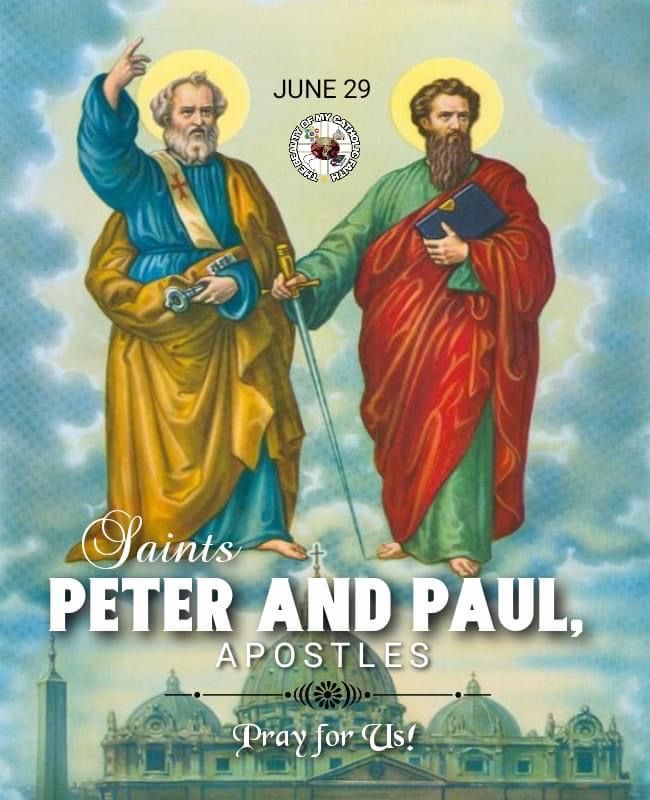
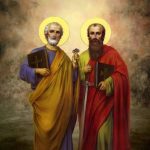
Feast of Saints Peter and Paul, Apostles
Today the Church joyfully celebrates the Solemnity of Saints Peter and Paul, the two great pillars upon whom Christ strengthened the early Church through different but complementary missions. Though they came from very different backgrounds, God’s grace transformed both men into fearless witnesses of the Gospel, reminding us that holiness is not determined by one’s past but by one’s response to God’s call.
Saint Peter, originally named Simon, was the son of Jonah and the brother of Andrew. A native of Bethsaida on the shores of the Sea of Galilee, he earned his living as a fisherman. Before meeting Jesus, he may have been among those influenced by the preaching of John the Baptist (Jn 1:35-42). It was Andrew who brought him to Christ, and from their very first encounter Jesus gave Simon a new name, Cephas, meaning “Rock” (Jn 1:42). This new name foreshadowed his unique mission within the Church.
Peter became the spokesman of the Apostles and was chosen by Christ to strengthen his brethren (Lk 22:31-32). At Caesarea Philippi, inspired by the Father, he boldly professed, “You are the Christ, the Son of the living God” (Mt 16:16). In response, Jesus entrusted him with the keys of the Kingdom of Heaven, declaring that upon this rock He would build His Church, and the powers of death would never prevail against it (Mt 16:18-19). Although Peter stumbled by denying Jesus during the Passion, he was restored through the Lord’s merciful love after the Resurrection when Christ entrusted him with the care of His flock three times, saying, “Feed my sheep” (Jn 21:15-17). Filled with the Holy Spirit at Pentecost, Peter courageously preached the risen Christ, leading about three thousand people to baptism in a single day (Acts 2:14-41). He later presided over the Council of Jerusalem (Acts 15), strengthening the unity of the early Church, and under the inspiration of the Holy Spirit wrote two pastoral letters. According to ancient Christian tradition, Peter was martyred by crucifixion during the persecution of Emperor Nero around A.D. 64. Out of humility, he requested to be crucified upside down because he considered himself unworthy to die in the same manner as his Master. His tomb beneath St. Peter’s Basilica in Rome continues to draw millions of pilgrims who honor the first Bishop of Rome and visible head of the universal Church.
Saint Paul presents a strikingly different story. Born in Tarsus, educated under the renowned Rabbi Gamaliel (Acts 22:3), and deeply committed to Pharisaic Judaism, Saul initially became one of the fiercest persecutors of the Church. Yet the risen Christ dramatically encountered him on the road to Damascus (Acts 9:1-19), transforming the persecutor into the greatest missionary of Christianity. Chosen as the Apostle to the Gentiles (Acts 13:46-47; Rom 11:13), Paul devoted every aspect of his life to proclaiming the Gospel across Asia Minor, Greece, and eventually Rome. Despite imprisonments, beatings, shipwrecks, and countless hardships (2 Cor 11:23-28), nothing could separate him from his love for Christ (Rom 8:35-39). His letters, thirteen of which are universally recognized in the New Testament, together with the Letter to the Hebrews, traditionally associated with him in the Latin Church, profoundly shaped Christian theology, spirituality, and pastoral life. Eventually, because he was a Roman citizen, Paul was executed by beheading during Nero’s persecution at Tre Fontane. He was buried where the magnificent Basilica of St. Paul Outside the Walls now stands. After Jesus Himself, no other New Testament figure has influenced the spread and theological understanding of Christianity more profoundly than Paul. Recognizing his immense contribution, Pope Benedict XVI proclaimed the Pauline Year from June 29, 2008, to June 29, 2009, marking approximately two thousand years since the Apostle’s birth.
Scripture Reflection
The Gospel (Mt 16:13-19) records one of the most decisive moments in the public ministry of Jesus. At Caesarea Philippi, amid temples dedicated to pagan gods, Jesus asked His disciples a deeply personal question: “Who do you say that I am?” Peter’s confession was not the product of human reasoning but a revelation from the Father. His declaration that Jesus is “the Christ, the Son of the living God” became the foundation of apostolic faith and the confession upon which the Church continues to stand. Immediately after this profession, Jesus began revealing that the Messiah would accomplish His mission not through worldly power but through suffering, death, and resurrection (Mt 16:21-23). Thus, authentic discipleship requires both correct faith in Christ and a willingness to follow Him along the way of the Cross before sharing in His glory.
Life Messages
1. Let us profess Jesus as our Lord and Savior with unwavering faith.
Peter’s confession must become our own. Jesus is far more than an inspiring moral teacher, a prophet, or the founder of a religion. He is the eternal Son of God made flesh, the Savior of the world, and the only mediator between God and humanity (Jn 14:6; 1 Tim 2:5). To acknowledge Him as Lord means allowing Him to reign over every area of our lives, our families, our work, our relationships, our decisions, and our future. Like Peter, we may sometimes fail, yet sincere repentance always opens the door to Christ’s mercy and restoration.
2. Let us imitate the courage, humility, and missionary zeal of Peter and Paul.
The lives of these two Apostles reveal that God does not call the perfect, He perfects those He calls. Peter teaches us that our weaknesses need not define our future when entrusted to Christ. Paul reminds us that no sinner is beyond the reach of God’s transforming grace. We encounter Jesus daily by prayerfully meditating on Sacred Scripture, participating devoutly in the Holy Eucharist, receiving the Sacraments frequently, and cultivating a life of personal and communal prayer. Like Peter feeding Christ’s sheep and Paul tirelessly preaching to the nations, we are sent to become missionary disciples. Every act of charity, every word of encouragement, every defense of the truth, every work of forgiveness, and every sacrifice made for the Gospel becomes a living proclamation that Christ is alive. When we serve the poor, welcome the stranger, comfort the suffering, and love even our enemies, we imitate the witness of Peter and Paul, recognizing the face of Christ in every person (Mt 25:31-46). Their martyrdom reminds us that the greatest testimony to faith is not merely what we say about Christ, but how faithfully we live and, if necessary, suffer for Him. God bless you.
June 30 Tuesday: The first martyrs of the Holy Roman Church. Mt 8:23-27
In today’s Gospel (Mt 8:23-27), Saint Matthew uses the miracle of the calming of the storm to reveal not only the extraordinary power of Jesus but also His true identity as the promised Messiah and the eternal Son of God. For Matthew, miracles are never mere displays of divine power. They are signs that unveil who Jesus truly is and invite people to place their complete trust in Him. Just as God alone exercises authority over the forces of nature in the Old Testament (Ps 89:9; Ps 107:28-30; Job 38:8-11), Jesus speaks with the same divine authority, commanding the wind and the sea, and they immediately obey Him. In doing so, Matthew presents Jesus as Emmanuel, “God with us” (Mt 1:23), whose presence brings peace amid life’s greatest turmoil.
This miracle also carried a profound message for Matthew’s first-century Christian community, many of whom endured persecution, rejection, and uncertainty. The fragile boat tossed by violent waves became a powerful image of the Church navigating through the storms of history. Matthew reassures believers that although the Church may appear overwhelmed by trials, it will never be destroyed as long as Christ remains in her midst. The same assurance continues to strengthen Christians today. No storm, whether personal, social, or spiritual, is greater than the Lord who remains present with His people.
The Storm on the Sea
The Sea of Galilee, though commonly called a sea, is actually a freshwater lake measuring about thirteen miles from north to south and approximately eight miles across at its widest point. Because it lies deep below sea level and is surrounded by hills and narrow valleys, it is well known for sudden and violent storms. Cold winds rushing through the surrounding ravines collide with the warm air over the lake, producing fierce waves capable of overwhelming even experienced fishermen.
It was during one of these unexpected storms that the disciples found themselves in grave danger. Many of them were seasoned fishermen who knew the lake well, yet this storm was beyond their ability to control. Fear replaced confidence, and panic overshadowed faith. Meanwhile, Jesus remained peacefully asleep in the boat, demonstrating complete trust in the Father’s providence. Convinced that they were about to perish, the disciples cried out, “Lord, save us! We are perishing!” (Mt 8:25). Before calming the sea, Jesus first addressed the deeper storm within their hearts by asking, “Why are you afraid, O you of little faith?” Only then did He rebuke the winds and the sea, and an extraordinary calm followed immediately. The miracle left the disciples filled with awe as they asked, “What sort of man is this, that even the winds and the sea obey him?” (Mt 8:27). Their question points beyond the miracle itself to the mystery of Christ’s divine identity.
Life Message
1. We must invite Jesus into the boat of our lives and trust Him in every storm.
Every human life resembles a journey across the sea toward the eternal shore of God’s Kingdom. Along the way, no one is exempt from storms. Some are physical, such as illness, financial hardship, or natural disasters. Others are emotional, including grief, loneliness, disappointment, and broken relationships. Still others are spiritual, manifesting as temptation, discouragement, doubt, fear, or periods when God seems silent. Like the disciples, we often become overwhelmed and imagine that the Lord has abandoned us simply because He appears silent. Yet His silence is never His absence.
The Scriptures repeatedly remind us that God accompanies His people through every trial. He walked with Israel through the Red Sea (Ex 14), remained with the three young men in the fiery furnace (Dan 3:24-25), protected Jonah in the depths of the sea (Jon 2), and sustained Paul through shipwreck and countless hardships (Acts 27). Above all, Jesus Himself passed through suffering, death, and resurrection, transforming the greatest human tragedy into the source of eternal hope.
When we welcome Christ into the boat of our lives through daily prayer, meditation on Sacred Scripture, frequent reception of the Sacraments, especially the Holy Eucharist and Reconciliation, and unwavering trust in Divine Providence, we discover a peace that circumstances cannot destroy. He calms the storms of grief by offering hope, quiets the storms of anxiety by reminding us of the Father’s loving care (Mt 6:25-34), strengthens us against the storms of temptation (1 Cor 10:13), and restores peace to hearts troubled by anger, resentment, or fear. Sometimes Jesus calms the storm around us, but often He first calms the storm within us, giving us the grace to persevere with faith until the waves finally subside. The presence of Christ does not guarantee a life without storms, but it assures us that no storm can ever separate us from His saving love (Rom 8:35-39). God bless you.
July 1 Wednesday. Mt 8:28-34
Gospel Reflection
Today’s Gospel (Mt 8:28-34) vividly reveals the absolute authority of Jesus Christ over the powers of evil. After calming the storm on the Sea of Galilee, Jesus crossed into the predominantly Gentile region of the Gadarenes, also identified as the country of the Gerasenes in the parallel accounts of Mark and Luke. This territory formed part of the Decapolis, a federation of Greek-speaking cities east of the Jordan River. There, Jesus encountered two men who were possessed by demons and lived among the tombs, a place considered ritually unclean and symbolic of death, isolation, and the destructive power of sin. While Matthew records two possessed men, Mark (5:1-20) and Luke (8:26-39) focus on one, probably because he became the more prominent witness to Christ’s saving power.
Before Jesus uttered a single command, the demons recognized His true identity, crying out, “What have you to do with us, Son of God?” (Mt 8:29). Ironically, the evil spirits acknowledged what many human beings failed to recognize, that Jesus is the divine Son of God whose authority extends over every spiritual power. In Mark and Luke, the demons identify themselves as “Legion,” a term referring to a Roman military unit consisting of several thousand soldiers, symbolizing the overwhelming grip that evil had upon the possessed man. Yet even such a multitude of demons proved powerless before the command of Christ. At their request, Jesus permitted them to enter a nearby herd of swine, animals regarded as unclean according to Jewish law (Lev 11:7). Immediately the herd rushed down the steep bank into the sea and perished. This dramatic event illustrates the destructive nature of Satan, whose ultimate purpose is always to steal, kill, and destroy (Jn 10:10), while Christ comes to restore life and freedom.
Instead of rejoicing over the miraculous liberation of the possessed men, the townspeople were overwhelmed by the loss of their livestock. Concerned more about their economic interests than the restoration of two human lives, they begged Jesus to leave their territory. Their response exposes the tragedy of a heart attached to material possessions more than to God. Whenever wealth, comfort, prestige, or worldly success become more important than the transforming presence of Christ, we risk repeating the same mistake by silently asking the Lord to leave the areas of our lives that we refuse to surrender. The Gospel reminds us that the value of a human soul far exceeds every earthly possession (Mk 8:36).
Life Messages
1. Jesus invites us to come out of the tombs that imprison us.
The tombs in today’s Gospel represent far more than physical graves. They symbolize every place of spiritual death where sin, fear, guilt, or hopelessness keeps us separated from God and from others. Sometimes these tombs are hidden deep within our hearts, sealed by resentment, pride, despair, unforgiveness, or indifference to God. At other times they appear in the form of addictions to alcohol, drugs, pornography, gambling, social media, or material wealth. Others become trapped in the tombs of selfish ambition, workaholism, unhealthy relationships, or the constant pursuit of worldly approval. Like the possessed men, many people today wander through life wounded, isolated, and searching for peace in places where it can never be found.
Jesus, however, enters even the darkest places that others avoid. He is not intimidated by the power of evil, nor does He abandon those who have lost hope. Just as He called Lazarus from the tomb (Jn 11:43-44), delivered Mary Magdalene from demonic oppression (Lk 8:2), forgave the sinful woman (Lk 7:36-50), and transformed Saul the persecutor into Paul the Apostle (Acts 9:1-19), He continues to liberate those who turn to Him with faith. Through His saving death and Resurrection, Christ has conquered sin, Satan, and death forever (Heb 2:14-15).
The Lord continues this ministry of liberation through His Church, especially in the Sacraments. In Baptism we are freed from the dominion of sin, in the Sacrament of Reconciliation we experience His healing mercy, and in the Holy Eucharist we receive the strength to persevere in holiness. If we allow Christ to enter every corner of our lives, He will replace fear with peace, bondage with freedom, despair with hope, and spiritual death with the abundant life He came to give (Jn 10:10). True freedom is found not in doing whatever we desire, but in belonging completely to Christ, who alone makes us sons and daughters of God and heirs of eternal life. God bless you.
July 2 Thursday: Mt 9:1-8
Jesus Demonstrates His Authority to Forgive Sins
In today’s Gospel, Jesus reveals a unique aspect of his divine authority by forgiving the sins of a paralyzed man before healing him. The physical miracle serves as visible proof that Jesus, as God incarnate, has the power to forgive sins and restore people spiritually as well as physically. Through this miracle, Jesus shows that he came to save, renew, and reconcile humanity with God.
2. The Connection Between Sin and Healing
Many Jews believed that sickness was a consequence of personal or inherited sin and that healing could come only after forgiveness. Therefore, Jesus first assured the paralytic that his sins were forgiven, restoring his relationship with God before restoring his body. The scribes accused Jesus of blasphemy because only God could forgive sins. By healing the man after forgiving his sins, Jesus demonstrated both his divinity and the close relationship between spiritual healing and physical well-being.
3. Life Message
The heart of the Christian faith is God’s forgiveness. Jesus has entrusted his Church with the ministry of reconciliation, inviting us to experience his mercy in the Sacrament of Reconciliation. As we receive God’s forgiveness, we are also called to forgive those who have wronged us and to seek God’s mercy daily, allowing his grace to bring healing, peace, and renewal to our lives. God bless you.
July 3 Friday: St. Thomas, Apostle:Jn 20:24-29
The Faith of St. Thomas
Today the Church celebrates the feast of Saint Thomas the Apostle. After missing Jesus’ first appearance to the disciples, Thomas refused to believe in the Resurrection unless he could personally see and touch the wounds of Christ. A week later, Jesus appeared again and invited Thomas to do exactly that. Overwhelmed by the encounter, Thomas made the profound profession of faith, “My Lord and my God!” Jesus then blessed all who would believe without seeing, extending that blessing to every future believer.
2. Thomas’ Profession of Faith
Thomas’ declaration, “My Lord and my God,” is one of the clearest affirmations of Jesus’ divinity in the New Testament. It confirms that the risen Jesus is truly God and forms a cornerstone of Christian faith. Thomas’ faith was not merely intellectual. It led him to total self-surrender, missionary zeal, and courageous witness. According to Christian tradition, he brought the Gospel to India around A.D. 52, established Christian communities there, and sealed his faith with martyrdom around A.D. 72.
3. Life Message 1
Authentic faith leads to loving service. Like St. Thomas, we are called not only to believe in Christ but also to express that faith through acts of charity, self-sacrifice, and obedience to Christ’s mission. As Scripture teaches, “Faith without works is dead” (James 2:17).
4. Life Message 2
We strengthen our faith by developing a personal relationship with Jesus through daily reading and meditation on Sacred Scripture, faithful personal and communal prayer, frequent reception of the Holy Eucharist, Eucharistic Adoration, and regular repentance through the Sacrament of Reconciliation. These spiritual practices help our faith become living, mature, and fruitful. God bless you.
July 4 Saturday: Mt 9:14-17
The Question About Fasting
Some disciples of John the Baptist asked Jesus why they and the Pharisees fasted regularly while Jesus’ disciples did not. Since prayer, fasting, and almsgiving were central practices of Jewish religious life, they were genuinely seeking to understand why Jesus’ followers seemed to feast instead of fast.
2. Jesus’ Reply Through Three Metaphors
Jesus answered by using three images: the wedding guests, the new patch on an old garment, and new wine in old wineskins. He compared his disciples to wedding guests who celebrate while the bridegroom is with them, explaining that fasting would come later when he was taken away through his Passion. Through the images of the cloth and wineskins, Jesus taught that his new covenant could not be confined within old ways of thinking. His followers needed open minds and receptive hearts to embrace the new life and teachings he brought.
3. Life Message
Christians are called to be spiritually flexible and open to the guidance of the Holy Spirit. While remaining faithful to Sacred Scripture and the Sacred Tradition of the Church, we should willingly accept authentic developments in the Church’s teaching, worship, and pastoral life. An open heart and a teachable spirit enable us to grow continually in faith and discipleship. God bless you.


Thank you for sharing
Thank you Fr and may God bless you 🙏
Amen