





April 6 Monday: Mt 28:8-15
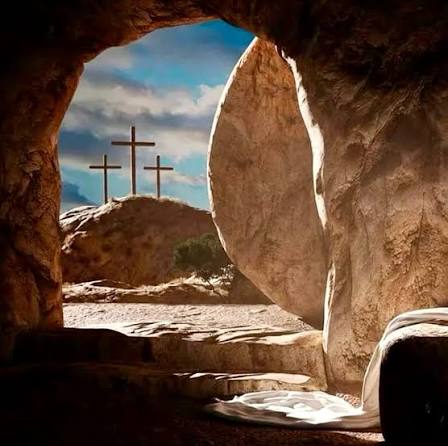
Today’s Gospel brings us to the empty tomb, the place where sorrow turns into joy, where confusion gives way to faith.
Very early in the morning, Mary Magdalene and the other Mary went to the tomb. These were the same women who had stood faithfully at the foot of the Cross when many others had fled. Love brought them there, even in grief.
But what they found was unexpected.
The stone was rolled away. The tomb was empty.
What they expected to find was a dead body.
What they encountered was the beginning of a new creation.
From Fear to Joy
At first, there was shock, confusion, even fear. But as they ran to tell the disciples, something extraordinary happened.
They met the risen Jesus.
He greeted them, not with reproach, but with peace. Then He entrusted them with a mission:
“Go and tell my brothers…”
These women became the first witnesses of the Resurrection, the first messengers of Easter. In a beautiful reversal, those who stayed at the Cross are now the first to proclaim the victory.
The Contrast: Truth and Falsehood
At the same time, the guards reported what had happened. But instead of accepting the truth, the authorities chose to suppress it. They bribed the soldiers to spread a false story.
Here we see a powerful contrast:
- The women respond with faith and courage
- The authorities respond with fear and manipulation
The Resurrection demands a response. It cannot be ignored.
What Does the Resurrection Mean for Us?
1. The foundation of our faith
The Resurrection is not just one event among many. It is the heart of Christianity.
As Saint Paul the Apostle teaches, “If Christ has not been raised, your faith is in vain” (1 Corinthians 15:14).
Everything we believe stands on this truth:
Christ is alive.
2. The living presence of Jesus
The risen Lord is not distant. He is present:
- In the Holy Eucharist
- In the Word of God
- In the praying community
- In every believer
We are never alone. The One who conquered death walks with us daily.
3. A call to become witnesses
Like the two Marys, we are sent.
We are called to:
- Share the joy of the Resurrection
- Recognize Christ in others
- Serve Him in the people around us
We are invited to become, in a real sense, “apostles to others”, carrying the Good News into our world.
Conclusion
Easter is not just a celebration of what happened to Jesus.
It is a celebration of what happens to us.
- Fear becomes courage
- Sin is forgiven
- Death gives way to life
The tomb is empty.
Christ is risen.
And because He lives, we too shall live.
Let us go forth like the women of the Gospel, with faith in our hearts, joy in our steps, and the courage to proclaim:
Christ is truly risen! Alleluia!
April 7 Tuesday: Jn 20:11-18
Today’s Gospel gives us one of the most beautiful and personal moments in all of Scripture, the encounter between the risen Jesus and Mary Magdalene.
She goes to the tomb early in the morning, carrying sorrow, confusion, and love. But instead of closure, she finds an empty tomb.
And yet, even when Jesus stands before her, she does not recognize Him.
The Mystery of Gradual Recognition
This moment reflects a pattern we often see in the Gospel of Gospel of John, that understanding comes gradually.
- Nicodemus struggles to understand being “born again” (John 3)
- The Samaritan woman slowly discovers Jesus as the Messiah (John 4)
Now Mary stands before the risen Lord, yet thinks He is the gardener.
Why?
Because she is overwhelmed by grief.
Because she is focused on loss.
Because she assumes the worst, that the body has been stolen.
Her tears blur not only her eyes, but her faith.
The Turning Point: Being Called by Name
Everything changes in one moment.
Jesus calls her: “Mary.”
That single word opens her eyes.
She recognizes Him, not by sight, but by relationship.
This is deeply personal.
God does not save us as a crowd.
He calls each of us by name.
From Encounter to Mission
Once Mary recognizes Jesus, she is immediately sent:
“Go to my brothers…”
She becomes the first witness of the Resurrection, the first to proclaim:
“I have seen the Lord” (John 20:18).
As Thomas Aquinas beautifully noted, sometimes simple, faithful love sees more clearly than great intellectual knowledge.
What Does This Mean for Us?
1. We can fail to recognize Jesus
Like Mary, we can miss His presence:
- Because we are distracted
- Because we are burdened by grief
- Because we are blinded by sin or routine
Sometimes Jesus is right in front of us, in people, in situations, in daily life, and we do not see Him.
2. We must listen for His voice
Recognition comes when we allow Him to speak to us.
We hear His voice:
- In prayer
- In the Sacraments, especially the Eucharist
- In the Word of God
It is there that He calls us by name again and again.
3. We are called to be witnesses
Mary did not keep the experience to herself.
She went and proclaimed:
“I have seen the Lord.”
That is the essence of Christian life, to encounter Christ and to share Him.
Conclusion
The Resurrection is not just about an empty tomb.
It is about a living relationship.
Jesus still stands near us.
He still calls us by name.
The question is:
Will we recognize Him?
And when we do, will we go and tell others?
Christ is truly risen! Alleluia!
April 8 Wednesday: Luke 24:13-35
Easter Reflection: Recognizing Jesus on the Road to Emmaus
The Emmaus story, found only in the Gospel of Luke, is one of the most touching resurrection appearances of Jesus.
Two disciples are walking away from Jerusalem. They are not just traveling, they are leaving behind their hope.
Their dreams have been shattered.
They had hoped that Jesus would conquer the Romans and establish a glorious kingdom.
Instead, they saw Him crucified.
Disappointed, confused, and heartbroken, they walk away.
Jesus Walks With Them, Unrecognized
As they walk, the risen Jesus joins them.
But they do not recognize Him.
Why?
Because they are trapped in their disappointment.
Because their expectations of the Messiah were different.
Because sorrow has clouded their understanding.
Yet, even in their confusion, Jesus does not abandon them.
He walks with them. He listens to them. He enters their pain.
From Confusion to Understanding
Jesus begins to explain the Scriptures.
He shows them that the suffering and death of the Messiah were not a failure, but the fulfillment of God’s plan.
Slowly, their hearts begin to change.
Later, they will say:
“Were not our hearts burning within us…?”
This is what happens when God’s Word is opened to us, it enlightens, it heals, it rekindles hope.
The Breaking of the Bread
Yet, they still do not fully recognize Him.
It is only at table, when Jesus takes bread, blesses it, breaks it, and gives it to them, that their eyes are opened.
In that moment, they recognize Him.
Then He vanishes.
This “breaking of the bread” becomes a central expression for the Eucharist in the early Church, especially in the Acts of the Apostles (Acts 2:42, 46; 20:7).
From that moment on, Christians recognize the risen Lord in the Eucharist.
What Does This Mean for Us?
1. Jesus walks with us in every moment
Whether in joy or sorrow, success or disappointment, the risen Lord is always near.
When life breaks us, through loss, illness, failure, or broken relationships, He is not absent. He is walking beside us.
2. We meet Him in Word and Eucharist
Like the disciples, we encounter Jesus in two powerful ways:
- In the Word of God, which enlightens our minds
- In the Eucharist, which opens our eyes
Every Mass is an Emmaus experience:
First, the Scriptures are explained, then the Bread is broken.
3. We must grow in awareness of His presence
As Augustine of Hippo once wrote:
“You were with me, but I was not with You.”
Jesus is often near, but we are distracted.
He speaks, but we are not listening.
We need to:
- Speak to Him in prayer
- Listen to Him in Scripture
- Recognize Him in daily life
Conclusion
The story of Emmaus is our story.
We all have moments when:
- Our hopes are shattered
- Our faith feels weak
- Our direction seems unclear
But the good news is this:
Jesus walks with us.
Jesus speaks to us.
Jesus reveals Himself to us.
And when we truly recognize Him, especially in the breaking of the bread, our sadness turns into mission.
Like the disciples, we rise, we return, and we proclaim:
The Lord is truly risen!
April 9 Thursday: Lk 24:35-48
Gospel Reflection: The Risen Lord Appears to His Apostles
Today’s Gospel presents the first appearance of the Risen Lord to His apostles. This moment occurs while they are still listening to the testimony of the two disciples who encountered Jesus on their way to Emmaus (cf. Lk 24:13–35). Suddenly, Jesus stands among them. Yet instead of immediate joy, they are filled with fear and doubt.
To strengthen their faith, Jesus offers them concrete proof of His Resurrection. He shows them His hands and feet, still bearing the marks of the wounds. He even asks for food and eats a piece of broiled fish before them. These actions affirm that His Resurrection is real, bodily, and not a mere vision or illusion (cf. Lk 24:36–43).
Jesus then opens their minds to understand the Scriptures. He explains that His Passion, Death, and Resurrection were not accidents of history but the fulfillment of God’s plan foretold in the Law of Moses, the Prophets, and the Psalms (cf. Lk 24:44–46). Everything that happened was in accordance with God’s saving will.
From this understanding flows a mission: repentance and the forgiveness of sins are to be preached to all nations. This mission begins with the apostles and continues in the Church until the end of time (cf. Lk 24:47–48).
Life Messages
1. We are called to be witnesses of the Resurrection.
Like the apostles, we are sent to proclaim that Jesus is alive. Our witness is not only in words but in the way we live, forgive, love, and remain hopeful even in difficult moments (cf. Acts 1:8).
2. We need a living awareness of the presence of the Risen Lord.
The apostles moved from fear to courage because they encountered Jesus personally. In the same way, our Christian life becomes strong when we recognize His presence:
- in the Holy Eucharist (cf. 1 Cor 11:23–26),
- in the Word of God (cf. Heb 4:12),
- in the community of believers (cf. Mt 18:20).
3. Faith grows through encounter and understanding.
The apostles doubted at first, yet Jesus patiently led them to faith. Our doubts, struggles, and questions can also become pathways to deeper faith when we remain open to God’s Word and grace.
Conclusion
The Resurrection is not just a past event, it is a present reality. The same Jesus who stood among the apostles stands among us today, offering peace, strengthening our faith, and sending us out as His witnesses.
Let us, then, live with conviction and joy, proclaiming with our lives what the apostles came to believe:
“The Lord is truly risen!”
April 10 Friday: Jn 21:1-14
Gospel Reflection: The Risen Lord Meets His Disciples at the Sea
Today’s Gospel, taken from Gospel of John (Jn 21:1–19), presents the Risen Jesus’ persistent and loving search for His apostles. Even after the Resurrection, the disciples return to fishing, perhaps because of uncertainty, fear, or the need to survive. Yet Jesus does not abandon them. He comes in search of them right where they are.
This appearance, the third recorded by John, shows clearly that the Resurrection is not an illusion or a hallucination. Jesus stands on the shore, speaks to them, guides them, and even prepares breakfast for them. The miraculous catch of fish becomes a symbol of their future mission, to gather souls into the Kingdom of God.
After the meal, Jesus turns to Simon Peter. Three times He asks, “Do you love me?” (Jn 21:15–17). This threefold question gently heals Peter’s threefold denial. Each time Peter affirms his love, Jesus entrusts him with a mission: “Feed my lambs… Tend my sheep.” Love for Christ is inseparable from responsibility for others. Finally, Jesus reveals that fidelity to this mission will lead Peter to sacrifice, even martyrdom.
Life Messages
1. We need to recognize the Risen Lord in our daily lives.
Like the apostles, we may fail to recognize Jesus when He stands near us. Yet He comes to us in ordinary and unexpected ways, in our work, struggles, and relationships.
2. The Risen Lord is present in our successes.
Every blessing, achievement, and breakthrough carries His hidden presence. Too often we celebrate the gift but forget the Giver (cf. Jas 1:17).
3. The Risen Lord is present in our suffering.
Moments of pain can become encounters with Christ. The transformation of Saul on the road to Damascus, described in Acts of the Apostles 9:1–19, shows how suffering and interruption can open the way to deeper faith and mission.
4. The Risen Lord comes through people.
He visits us through friends, helpers, and even strangers who support us in times of need. These encounters are often quiet signs of His care.
5. The Risen Lord is present in the Church’s worship.
We meet Him:
- in the Holy Eucharist,
- in the Word of God,
- in the Sacraments, especially Reconciliation,
- and in the gathered community (cf. Gospel of Matthew 18:20).
Conclusion
The Gospel reminds us that Jesus never stops searching for us. Whether we are strong or weak, faithful or struggling, He comes to meet us where we are.
He feeds us, forgives us, restores us, and then sends us out.
The real question is the same one He asked Peter:
“Do you love me?”
And our answer must be shown not only in words, but in how we care for others. God bless you.
April 11 Saturday: Mk 16:9-15
Gospel Reflection: The Universal Mission of the Risen Lord
Today’s Gospel, from Gospel of Mark (Mk 16:9–15), summarizes three appearances of the Risen Jesus and culminates in His great missionary command.
According to Mark’s longer ending, Jesus first appeared to Mary Magdalene. She faithfully reported this to the apostles, but they did not believe her. Then Jesus appeared to two disciples on their way, an event also described in Gospel of Luke (Lk 24:13–35). Yet even their testimony was met with doubt.
Finally, Jesus appeared to the eleven apostles themselves. He gently rebuked them for their unbelief and hardness of heart. Then, despite their weakness, He entrusted them with a عظ mission:
“Go into the whole world and proclaim the Gospel to every creature” (Mk 16:15).
This is the universal apostolic mandate, the foundation of the Church’s missionary identity.
Life Messages
1. The mission of preaching belongs to the whole Church.
In a special way, this mission is entrusted to the successors of the apostles, the bishops, in communion with the Pope. They are the primary teachers and guardians of the faith (cf. Apostolicum Actuositatem, no. 2).
2. Every Christian shares in this mission.
The Second Vatican Council teaches clearly that the Church exists to spread the Kingdom of Christ throughout the world. Therefore, every baptized person has a role in evangelization, not only by words but by the witness of life.
3. God works through imperfect people.
The apostles doubted, hesitated, and struggled to believe. Yet Jesus still chose them and sent them. This reminds us that our weaknesses do not disqualify us, God can still use us if we are willing.
4. Faith must move from hearing to witnessing.
The apostles moved from disbelief to bold proclamation. In the same way, our faith must not remain private. It must become visible in how we live, speak, and relate to others.
Conclusion
The Gospel ends not with fear or doubt, but with mission.
The same command given to the apostles is given to us today.
To proclaim Christ, not only from the pulpit, but in our homes, workplaces, communities, and daily encounters.
The question is not whether we are perfect, but whether we are willing. God bless you.


I remain grateful father.
God bless you 🙏
🙏🏾
Thank you father.
God bless you 🙏
Amen
God bless you Father
Thank you very much Father
You are welcome