





Isaiah 7:10-14, Romans 1:1-7 , Matthew 1:18-24
Synopsis of the Readings
On this Fourth Sunday of Advent, the liturgy presents a profound convergence of divine promise and human response. Isaiah announces God’s decisive sign to a faithless king, revealing a fidelity that persists despite human failure. Paul proclaims this ancient pledge fulfilled in Jesus Christ, the Davidic Messiah revealed as Son of God, whose grace summons all nations. Matthew then draws us into the private crisis of Joseph, where the hinge of salvation history turns on a personal, trusting obedience. The readings collectively reveal that God’s saving initiative actively seeks and awaits human cooperation, framing Advent as a season of receptive partnership.
My dear people of God, the first reading from Isaiah places us within a precise and perilous historical moment around 735 BC. King Ahaz of Judah, threatened by a formidable northern coalition, is besieged by terror. The prophet Isaiah meets him at the conduit of the Upper Pool, a location symbolic of the city’s vulnerable water supply and Ahaz’s reliance on earthly resources. In a stunning offer of grace, God invites the king: “Ask for a sign from the Lord your God.” This is an opportunity to anchor his crumbling kingdom in divine covenant rather than in a desperate political alliance with Assyria. Ahaz, cloaking his lack of faith in false piety, refuses. His refusal is not humility but active disbelief, a choice of visible military power over invisible promise. Isaiah’s response is divinely authoritative: the Lord himself will give a sign. “The young woman shall conceive, and bear a son, and shall name him Immanuel.” The Hebrew word used here for “young woman” denotes a woman of marriageable age, but the nature of the sign—its character as a divine guarantee—points towards a fulfilment exceeding ordinary expectation. The name, “God with us,” is the prophecy’s core. It is a pledge of divine solidarity that will outlast the immediate political collapse. It should be noted that the sign is given not for Ahaz’s reassurance but for the faithful within the “house of David.” The child’s diet of curds and honey signifies a land stripped by warfare, a context of judgment, yet also of God’s sustaining provision in the aftermath. The promise, therefore, is of presence within desolation. Irenaeus saw here the early foreshadowing of the miraculous birth that would renew humanity itself (Against Heresies, 3.19.3).
A contemporary reflection of this dynamic occurred in a rural diocese in Ghana during a severe drought. Faced with failing crops and dwindling water, the community’s initial response mirrored Ahaz’s panic. However, the local bishop, recalling the narrative of the widow’s jar of oil, called for a day of prayer and communal sharing of resources. This act of collective trust did not instantly bring rain, but it fostered an organised system where families with deeper wells shared with those without, and food stores were pooled for the most vulnerable. Their faithful cooperation became a tangible “Immanuel” experience—a sign that God was with them in their endurance, providing through their own shared mercy. The divine sign was manifested not in the removal of the crisis, but in the grace-filled unity it inspired.
My brothers and sisters in Christ, the second reading from Romans presents the apostolic proclamation of that ancient sign’s fulfilment. Paul, writing to the Christians at the heart of imperial power, begins his Letter to the Romans with a condensed theology of history. He identifies himself as one set apart for the gospel of God, a gospel promised long ago through the prophets. With theological precision, he defines this gospel: it concerns God’s Son, who was descended from David according to the flesh—a direct fulfilment of the Davidic covenant—and was declared Son of God in power through his resurrection from the dead. This dual designation captures the incarnation’s essence: Jesus is both the fulfilment of Israel’s specific hope and the revelation of God’s universal power. From this reality flows Paul’s mission: to bring about the “obedience of faith” among all the Gentiles. This key phrase denotes not passive acceptance but an active, life-shaping alignment with the truth of the gospel. The grace and peace with which he greets them are the fruits of this obedience, flowing from “God our Father and the Lord Jesus Christ.” Scholars emphasise that for Paul, the Church’s very existence is an extension of the Christmas event, the lived reality of “God with us” across nations. Pope Benedict XVI noted that Paul presents Christianity not as a new ideology but as the transformative event of God’s grace arriving in person (General Audience, 15 October 2008).
This “obedience of faith” on a global scale finds a powerful, if secular, equivalent in the international medical response to the 2014 Ebola outbreak in West Africa. Health workers from nations like the United Kingdom, Canada, and Germany, moved by a commitment to human dignity beyond borders, voluntarily entered high-risk zones. Their service was an obedience to a call rooted in the value of human life, a principle deeply consonant with the gospel. They acted not for strategic advantage but from a sense of shared humanity, creating a network of solidarity in the face of a common threat. In a profoundly deeper way, Paul was commissioned to proclaim that in Jesus, God had acted for all, issuing a call to a faith that creates a new, grace-filled solidarity transcending every human division.
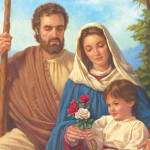
Dearly beloved, the Gospel narrative from Matthewbrings the cosmic promise into the hidden, anguished conscience of one righteous man, Joseph. Matthew’s account is carefully framed to highlight his pivotal role. Betrothed to Mary, he discovers her pregnancy and knows he is not the father. His righteousness, informed by the law of Moses, confronts a profound dilemma. The law permitted a public divorce, yet Joseph, being just and unwilling to expose her to disgrace, resolves on a quieter, merciful course. This reveals a righteousness that seeks to fulfil God’s heart of mercy, not merely its legal letter. At this juncture of compassion and confusion, God intervenes through a dream. The angel addresses him as “son of David,” directly linking him to the lineage of the promise. He is told not to fear and is entrusted with the astounding mystery: the child is conceived through the Holy Spirit. Joseph receives a twin mandate: to take Mary as his wife, and to name the child Jesus, for “he will save his people from their sins.” To bestow the name is to claim the child as his own, legally integrating him into the Davidic line. Matthew explicitly states this fulfils Isaiah’s prophecy: the child is “God with us,” and his mission is salvation from sin. Joseph’s response is the model of Advent faith: immediate, unhesitating, and total. He arises and obeys. Through this faithful “yes”, the Messiah enters human society with a name, a lineage, and a family. Exegetes observe that if Mary’s fiat allowed the Word to become flesh, Joseph’s fiat allowed him to enter a human story with a social identity and a history. Pope Francis reflects that Joseph teaches us the courage of trusting in God amidst life’s unforeseen disruptions (Patris Corde, section 4).
A poignant contemporary reflection of Joseph’s crisis comes from France. A man learned, after many years of marriage, that a profound secret from his wife’s past meant their eldest child was not biologically his. His immediate world of certainty shattered. The path of righteous withdrawal, supported by custom and raw emotion, lay open. After a period of silent turmoil and seeking counsel, he chose a different path. He chose to reaffirm his fatherhood, to daily “take the child and his mother” into the home of his heart through a deliberate, covenantal love. This decision did not erase the pain, but it transformed a narrative of betrayal into one of chosen redemption. Like Joseph, he was asked to accept a reality he did not plan, to give the full gift of his name and protection, and in doing so, became an instrument of healing and saving love within his own family.
Lessons to be drawn from the Readings.
The readings today summon us from fear to faithful collaboration. They challenge us to trust that God’s promise of presence is our sure foundation, especially when human strategies fail. They call us to the “obedience of faith,” allowing the grace of Christ to reshape our actions and extend our compassion universally. They invite us, most personally, to emulate Joseph’s righteous courage: to listen for God’s voice in our dilemmas, to choose merciful integrity over rigid judgment, and to offer our faithful “yes” even when the path is obscured. As Advent draws to a close, we are reminded that the coming of Emmanuel invariably depends upon our willing cooperation, transforming our ordinary obedience into the very means by which God’s saving plan takes flesh in our time.



So practical and encouraging, I am grateful.
Thank you