





OVERVIEW OF THE READINGS
The prophet Isaiah invites the people to come to the waters and receive nourishment freely, emphasising God’s generous offer of life. Saint Paul assures the Romans that nothing can separate believers from the love of Christ, not even suffering or death. The Gospel of Matthew presents the feeding of the five thousand, in which Jesus multiplies loaves and fish to satisfy a hungry multitude. The common thread running through these readings is God’s abundant and faithful provision for his people, a provision that outlasts human scarcity and opposition. Each reading, in its own particular way, invites the believer to set aside anxiety and self-reliance, and to trust instead in a divine generosity that cannot be exhausted.
REFLECTION
My dear People of God, the prophet Isaiah addresses a people who had endured decades of exile in Babylon. They had lost their land, their Temple, and much of their sense of identity. Many had grown weary and spiritually malnourished, wondering whether God had abandoned them for good. It is to this discouraged community that the prophet speaks, with an invitation both urgent and generous. He calls out to everyone who thirsts, summoning them to come to the waters. His imagery is drawn from the marketplace, where water, wine, and milk were sold as goods which the poor could rarely afford. The prophet declares, however, that these gifts are here offered without money and without price. This is not a commercial transaction but a gift from God, freely given, requiring not wealth but willingness, not merit but response. The word in the original language rendered as “thirst”describes a deep and intense longing that goes beyond physical need; it is the craving of the soul for something that satisfies completely.
The prophet then asks a pointed question: why do people spend their money on what is not bread, and their labour on what does not satisfy? He is exposing the futility of seeking lasting fulfilment in material possessions, political alliances, or misplaced religious confidence. Such pursuits consume human energy without nourishing the deeper hunger of the heart. This diagnosis remains relevant today, for many still labourto acquire what ultimately leaves the soul unsatisfied. The call to “listen” diligently carries particular weight here: the word in the original language means to incline the ear with attentive obedience, not simply to hear sounds but to respond in faith. Listening, in this sense, leads to life, for it connects the hearer to the source of all nourishment. The invitation culminates in the promise of an everlasting covenant, recalling God’s faithfulness to David. What was once the privilege of the monarchy now extends towards the whole community, a sign that God’s steadfast love endures despite human failure. In this way, the promises once attached to a single royal line become the shared inheritance of every believer.
A father and his young daughter once walked through a busy market. The child saw a vendor selling water and said, “Father, I am thirsty.” The father had no money with him, but a stranger nearby overheard and offered the girl a cup of water. She drank and smiled, refreshed. Her need had been met simply by receiving a gift. We come to God in much the same way, bringing our own thirst, and he gives freely and without cost. His grace is not something we earn; it is something we receive.
The early Church recognised in this invitation an anticipation of the grace later offered through Christ. Saint Augustine taught that the Lord himself is the true nourishment of the soul, and that the imagery of the banquet points towards communion with God beyond earthly realities (Expositions of the Psalms, 144). Saint Cyril of Alexandria saw in the everlasting covenant a sign of God’s mercy, extending securely towards all, beyond every human claim or privilege (Commentary on Isaiah).
Dearly beloved in Christ, Saint Paul writes to a community in Rome that had known considerable upheaval. Many believers had been expelled from the city under Claudius and, on their return, faced social suspicion, economic hardship, and the threat of persecution. It is to this vulnerable community that Paul addresses one of the most forceful affirmations of divine love found anywhere in his letters. He opens with a question: who shall separate us from the love of Christ? The word rendered “separate” in the original language means “to cut off or sever completely”. Paul is not speaking of a feeling of distance but asking whether any force can break the bond established through the saving work of Christ. He answers by naming seven afflictions: tribulation, distress, persecution, famine, nakedness, peril, and sword. These are not abstractions but real experiences of suffering, covering external pressure, inner anguish, hostile pursuit, material want, physical exposure, danger, and violent death. In naming them so precisely, Paul acknowledges that Christian suffering is real and often severe, while insisting that none of it has the power to annul the saving love of God. This is a pastoral word addressed to real and lived hardship, not a theoretical claim that remains untested by experience.
Paul then quotes Psalm 44, reminding his readers that suffering has long accompanied covenant fidelity. He does not promise an escape from hardship but proclaims something greater still: that believers are more than conquerors through Christ who loved them. The phrase “more than conquerors” in the original language describes a surpassing and complete victory, one that transforms the very circumstances of suffering into instruments of God’s purpose. This victory rests not on human endurance but on the love of Christ, already given. Paul widens his list further, naming every conceivable power: death, life, angels, principalities, things present, things to come, powers, height, and depth. Height and depth were astrological terms referring to the furthest extremes of the universe, and by naming them Paul leaves no dimension of existence unaccounted for. He concludes that nothing in all creation can separate believers from the love of God in Christ Jesus our Lord. This sweeping conclusion leaves no room for doubt whatsoever, since every conceivable threat, whether earthly, cosmic, or spiritual, has already been named and set beneath the sovereignty of that love.
A missionary imprisoned for his faith once received a letter from his mother. She wrote: “My son, your chains cannot hold you back from the love of God. Neither the prison walls nor the guards can separate you from Christ.” He read that letter every day and drew strength from it to endure. The love he received was greater than his confinement. We too may face trials, but they cannot sever us from the love of God.
The Fathers of the Church consistently read this passage as a proclamation of divine fidelity. Saint John Chrysostom observed that Paul deliberately exhausted every conceivable source of fear, so that no objection might remain against the certainty of God’s love (Homilies on Romans, Homily 15). Saint Ambrose taught that the victory of the Christian arises not from personal strength but from participation in the triumph of Christ himself (On the Duties of the Clergy, Book II).
My brothers and sisters in Christ, the feeding of the five thousand follows immediately upon the account in Matthew of the execution of John the Baptist. Herod Antipas, the client ruler of Galilee, had beheaded John to preserve his own standing, and his banquet of violence stands in stark contrast to the meal Jesus is about to provide. On hearing of the death of John, Jesus withdraws towards a lonely place, a withdrawal that reflects both sorrow and prudence. The crowds, however, follow him on foot from the surrounding towns, showing the depth of their need and expectation. Jesus receives them with “compassion”, a word in the original language meaning “to be moved in the deepest part of one’s being”. It is a deep empathy that issues in concrete action: he first heals the sick and then provides food for the hungry. In the Gospel of Matthew, compassion is always active and restorative, never simply a feeling. This pattern instructs us that authentic compassion must move beyond sentiment towards concrete and sustained care for those in need.
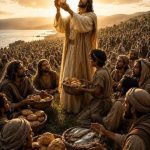
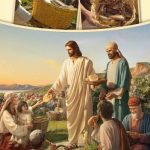
As evening approaches, the disciples suggest sending the crowd away to buy food, a reasonable and practical proposal. Jesus responds instead, “They need not go away; you give them something to eat.” This instruction places responsibility on the disciples and helps to reveal their insufficiency, for they have only five loaves and two fish. Their resources are plainly inadequate, yet Jesus commands them to bring what little they have towards him. He takes the loaves, looks up to heaven, blesses them, breaks them, and gives them to the disciples. These four actions, taking, blessing, breaking, giving, anticipate the language of the Last Supper. The disciples become the means through which the gift reaches the crowd. All eat and are satisfied, and twelve baskets of fragments remain. The number twelve recalls the twelve tribes of Israel, a sign of fulness and restoration; nothing is wasted, because the generosity of God is inexhaustible. About five thousand men were fed, besides women and children, indicating a vast multitude. The scale of the miracle underscores that divine provision is not merely sufficient but overflowing, exceeding every reasonable expectation drawn from the meagre resources at hand.
A small fishing village once faced a severe shortage of food. A boy offered his modest lunch to a visitor, who blessed the offering, and soon everyone in the village had enough to eat. His small gift, placed in generous hands, became more than sufficient. We bring our own limited offerings towards Christ in the same way, and he multiplies them beyond what we could expect.
The Fathers found deep significance in this miracle. Saint John Chrysostom noted that the hesitation of the disciples revealed the gradual growth of their faith, since they had not yet grasped the full extent of the power of Christ (Homilies on the Gospel of Matthew, Homily 49). Saint Augustine observed that the abundance of the miracle demonstrated the divine power of Christ, for he did not merely satisfy the multitude but provided more than they required (Sermons on the New Testament, Sermon 130).
THE REFLECTION IN A NUTSHELL
The three readings today proclaim the abundant and faithful provision of God for his people. Isaiah invites the thirsty to receive nourishment freely, without cost, because the grace of God cannot be bought. Saint Paul assures us that nothing in all creation can separate us from the love of Christ, not even suffering or death. The Gospel shows Jesus multiplying loaves to satisfy a hungry multitude, demonstrating that divine generosity overcomes human insufficiency. Together, these passages help us to see that the gifts of God are not commodities to be earned but blessings to be received. When we bring our modest resources towards Christ, he multiplies them beyond our expectations. The same God who invited Israel towards the waters invites us today to come, to listen, and to receive life. His love is unshakeable, his provision is abundant, and his covenant endures for ever. Let us respond with faith, trust, and gratitude, bringing our needs to the Lord who satisfies every hunger. May we, like the crowd on the hillside, learn to depend not on what we possess but on the one who provides.
