




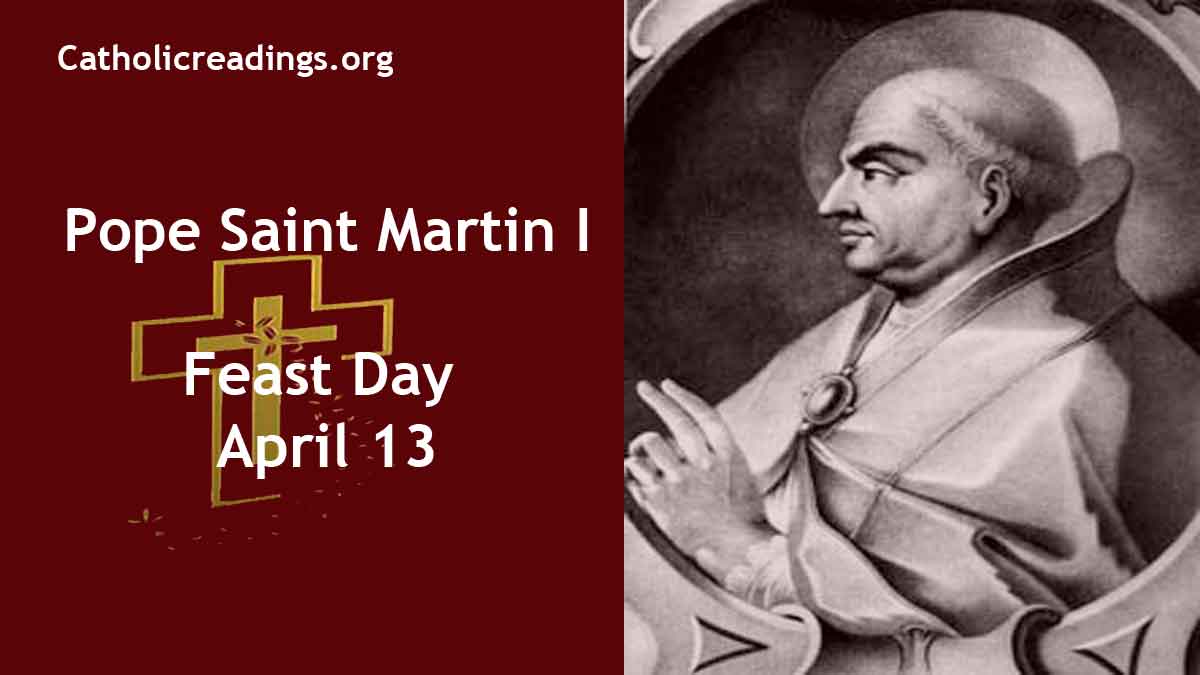
April 13 Monday: St. Martin I, Pope and Martyr: John 3:1-8
Today’s Gospel recounts the nighttime encounter between Jesus and Nicodemus, a prominent and wealthy Jewish rabbi who belonged to the Sanhedrin, the supreme council of seventy elders. The evangelist John later reveals Nicodemus’ courage: he boldly defended Jesus’ right to a fair hearing before the council (Jn 7:51) and, together with Joseph of Arimathea, provided a dignified burial for the crucified Lord (Jn 19:39-40).
Nicodemus approached Jesus convinced that strict observance of the Mosaic Law and the offering of Temple sacrifices were sufficient for attaining eternal life. Jesus, however, confronts him with a radical truth: “Unless one is born again of water and the Spirit, he cannot enter the kingdom of God” (Jn 3:5).
The Lord explains that every disciple lives two distinct lives and experiences two births. The first is the natural, physical birth from one’s mother, by which we become sons and daughters of our earthly parents. The second is the supernatural birth from God through Baptism, by which we become children of God, members of His family in the Church, and heirs of Heaven. This new birth is possible only when one is baptized into Christ and receives the indwelling gift of the Holy Spirit.
Jesus reinforces this teaching elsewhere in Scripture. He tells the Apostles, “Go therefore and make disciples of all nations, baptizing them in the name of the Father and of the Son and of the Holy Spirit” (Mt 28:19). St. Paul echoes the same reality when he writes that in Baptism we are “buried with Christ” so that “just as Christ was raised from the dead… we too might walk in newness of life” (Rom 6:4). The Apostle Peter likewise proclaims on Pentecost: “Repent and be baptized… for the forgiveness of your sins; and you shall receive the gift of the Holy Spirit” (Acts 2:38).
Life message:
We must never forget that rebirth by water and the Holy Spirit is not a one-time event but a continuous, lifelong process for every Christian. For this ongoing rebirth to bear fruit, we need, each day, to repent sincerely of our sins, renew our lives through persevering prayer and faithful participation in the sacraments, engage in meditative reading of Sacred Scripture, practice both corporal and spiritual works of mercy, and constantly seek the guidance of the Holy Spirit. God bless you.
April 14 Tuesday: Jn 3: 7-15
Today’s Gospel continues the nighttime conversation between Jesus and Nicodemus, a wealthy Jewish rabbi and member of the Sanhedrin, the council of seventy elders. Nicodemus sought clarification on whether faithful observance of the Mosaic Law and the prescribed Temple sacrifices were sufficient for attaining eternal salvation. Jesus seized this as a teachable moment, revealing to him the absolute necessity of spiritual rebirth through the power of the Holy Spirit, received in the water of Baptism, as the essential condition for entering the Kingdom of God.
Jesus illustrated the transforming effects the Holy Spirit produces in the souls of the baptized. Just as we perceive the presence, force, and direction of the wind by its effects, so it is with the Holy Spirit, the Divine “Breath” (pneuma). In Hebrew and Aramaic, the same word denotes “spirit,” “breath,” and “wind.” We cannot fully grasp how the Holy Spirit enters and renews the human heart, yet His presence becomes evident through the visible change in the conduct and life of the one who receives Him. This echoes the words of St. Paul: “The fruit of the Spirit is love, joy, peace, patience, kindness, generosity, faithfulness, gentleness, and self-control” (Gal 5:22-23).
Jesus further affirmed His heavenly origin, making His teaching utterly credible. Drawing from the Old Testament, He compared God’s deliverance of the Israelites when Moses raised the bronze serpent in the desert so that those bitten by serpents might look upon it and live (Num 21:8-9) to His own mission: “As Moses lifted up the serpent in the wilderness, so must the Son of Man be lifted up, that whoever believes in Him may have eternal life” (Jn 3:14-15). Thus, the crucified Lord would become the source of salvation for all humanity.
Life message:
We must continually adjust our way of living by recognizing and fully cooperating with the presence of the Holy Spirit within us. 1) Begin each day by asking for His divine strength and guidance, and end each day by seeking His pardon and forgiveness for our failings. 2) Pray daily for His anointing, and for the gifts, fruits, and charisms of the Spirit, so that we may truly live as children of God. 3) Open wide the shutters of our hearts and allow the Holy Spirit to enter the narrow caves of selfishness and fear in which we sometimes bury ourselves. God bless you.
April 15 Wednesday: John 3: 16-21
Jesus explained God’s plan of salvation to Nicodemus by pointing to the story of Moses and the brazen serpent as a prophetic sign of the Good News. Just as the Israelites were healed by looking upon the bronze serpent lifted up in the desert (Num 21:8-9), so the Son of Man must be lifted up on the Cross so that everyone who believes in Him might not perish but have eternal life. Jesus then proclaimed the heart of the Gospel: “For God so loved the world that He gave His only Son, so that everyone who believes in him might not perish but might have eternal life” (Jn 3:16). This verse stands as the sublime summary of the entire Gospel message, salvation freely offered through Christ Jesus.
Today’s Gospel passage reveals that our salvation is the free gift of a merciful God, bestowed upon us through His Incarnate Son. Jesus is the universal agent of salvation, not merely for one chosen nation, but for the sins of the whole world from its beginning to its end. Through these words, the Gospel teaches us that God has expressed His infinite love, mercy, and compassion by giving His only-begotten Son for our redemption. The initiative in salvation belongs entirely to God’s love for humanity. This echoes the words of St. John: “In this is love, not that we loved God but that He loved us and sent His Son to be the expiation for our sins” (1 Jn 4:10).
St. Augustine of Hippo recounts how his mother, St. Monica, who prayed and wept unceasingly for his conversion, received a consoling dream assuring her that God still loved her son despite his wayward life. This message convinced her to remain close to him rather than sever ties. Augustine’s journey beautifully illustrates the universality of God’s love. God’s motive is pure love, and His objective is the salvation of every soul. Those who receive eternal life must believe in the Son and express that faith through concrete deeds of love, as Jesus Himself taught: “Whoever believes in the Son has eternal life” (Jn 3:36), and “If you love me, you will keep my commandments” (Jn 14:15).
Life message:
1) We need to respond to God’s love for us by loving and serving Him in others, in whom He truly dwells. God’s love is unconditional, universal, forgiving, and merciful. During this Easter season, let us earnestly strive to reflect these same qualities in our relationships with others. “In the evening of life you will be examined on love,” said St. John of the Cross , and by “love” he means love expressed in generous deeds. God bless you.
April 16 Thursday; Jn 3:31-36
In today’s Gospel passage, Jesus reveals His Divinity to Nicodemus and clarifies His intimate relationship with God the Father and God the Holy Spirit. It is precisely this Divinity that gives divine authority and complete veracity to His teachings, and unshakable credibility to His promise of eternal life for all who believe in Him.
Jesus makes several solemn claims: 1) As the only-begotten Son of God, He “comes from Heaven” (Jn 3:13). Therefore, He speaks of heavenly realities from direct personal knowledge and experience, unlike any earthly teacher. 2) While the Jews believed that prophets received only a limited measure of God’s Spirit, Jesus, as the eternal Son, possesses the fullness of the Holy Spirit without measure (Jn 3:34). Hence, all His teachings and promises are utterly reliable and trustworthy. 3) Jesus alone grants eternal life to His followers: “He who believes in the Son has eternal life; he who does not obey the Son shall not see life, but the wrath of God rests upon him” (Jn 3:36).
Life messages: 1) We need to seek the daily guidance and strengthening of the Holy Spirit who dwells within us, for it is He who opens our minds to divine truths and grants us deeper, clearer understanding of the Scriptural teachings handed down by the Church.
2. Since our eternal destiny depends on our free daily choices, we must deliberately choose Christ and His teachings, courageously standing for His ideals even when they contradict the spirit of the age.
3. We need to choose Jesus in order to choose Life itself. Before his death, Moses placed before Israel a solemn challenge: “See, I have set before you this day life and good, death and evil… Therefore choose life, that you and your descendants may live, loving the Lord your God, obeying His voice, and cleaving to Him” (Dt 30:15-20). Joshua renewed this same challenge at Shechem: “Choose this day whom you will serve… but as for me and my house, we will serve the Lord” (Jos 24:15). We face this decisive choice every single day of our lives. God bless you.
April 17 Friday: John 6:1-15
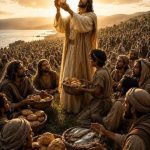
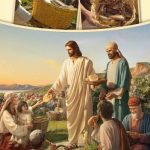
Today’s Gospel describes Jesus’ attempt to withdraw quietly with His disciples from the pressing crowds near Capernaum. He crossed the Sea of Galilee by boat to a lonely spot near the village of Bethsaida Julius, where a small grassy plain offered some solitude. Yet when He stepped ashore, a great multitude had already followed Him on foot. This became the setting for the miraculous feeding of the five thousand, the only miracle besides the Resurrection recorded in all four Gospels; a clear sign of its profound importance to the early Church.
Today’s Gospel passage calls us to become humble instruments in God’s hands by generously sharing our blessings with our brothers and sisters. The multiplication of the loaves and fish can be seen both as a striking work of Divine Providence and as a powerful Messianic sign pointing to Jesus as the true Bread from Heaven. The lesson for every Christian is that, no matter how daunting the task may appear, with God’s help it can be accomplished: “For with God nothing shall be impossible” (Lk 1:37). Jesus began the miracle with the generous offering of a young boy who gave all he had, five barley loaves and two fish, reminding us that love and self-giving are essential for God’s grace to flow freely. Selfishness, by contrast, obstructs the life-giving action of divine grace. The early Christian community cherished this account because they recognized in it a foreshadowing of the Holy Eucharist, where Christ feeds His people with His own Body and Blood.
Life message: 1) As Christians we need to commit ourselves to share all we have and all we are, cooperating with God in extending His compassion to everyone. God is a loving Father who desires our active participation. This is exactly what the first Christians did, as described in the Acts of the Apostles: “All who believed were together and had all things in common; they would sell their possessions and goods and distribute the proceeds to all, as any had need” (Acts 2:44-45).
2. We, and many in our own time, need the courage to share even when we feel we have little or nothing to offer. Whatever is placed into Jesus’ hands will be multiplied and produce abundant life-giving fruit in those who receive it.
3. The Gospel presents two contrasting attitudes: that of Philip and that of Andrew (Jn 6:7-9). Philip essentially declared the situation hopeless: “Two hundred denarii would not buy enough bread for each of them to get a little.” Andrew, however, brought the boy’s meager offering to Jesus with trust: “There is a boy here who has five barley loaves and two fish; but what are they among so many?” We are called to imitate Andrew’s attitude of generous trust rather than Philip’s spirit of defeat. God bless you.
April 18 Saturday: Jn 6:16-21
The event in today’s Gospel immediately follows Jesus’ miraculous feeding of the five thousand with five barley loaves and two fish. Perceiving that the enthusiastic crowd intended to seize Him and force Him to become their political king, Jesus urgently directed the Apostles to set out by boat while He dismissed the multitude. Then He withdrew alone to the mountain to pray in solitude.
A double miracle on the sea: When the disciples had rowed three or four miles from shore, a sudden violent storm arose, as the hot desert wind swept down through the ravines of the Golan Heights onto the Sea of Galilee. In their distress, Jesus came to them, walking on the turbulent waters. He calmed their fears with His reassuring words, and the moment He stepped into the boat, it immediately reached the land toward which they had been struggling.
Life messages: 1) We need to approach Jesus with confident faith in His power and readiness to calm the storms that arise in our personal lives and in the life of the Church. Church history bears eloquent witness: Jesus rescued His Church from the fierce storms of persecution during the first three centuries, from the storms of heresies in the fifth and sixth centuries, from the storms of moral decay and the Protestant Reformation in the sixteenth and seventeenth centuries, and from the storms of the clerical sex-abuse scandals that erupted especially in the twentieth and twenty-first centuries. As He once asked, “Why are you afraid, O you of little faith?” (Mt 8:26).
2. We need to turn to Jesus for protection whenever we face storms of powerful temptations, storms of doubt concerning our faith, and storms of fear, anxiety, and worry that threaten our daily lives. The Psalmist reminds us: “God is our refuge and strength, a very present help in trouble” (Ps 46:1).
3. Experiencing the saving presence of Jesus in our lives, we must openly confess our faith in Him and call upon Him earnestly for help and protection, just as Peter cried out, “Lord, save me!” when he began to sink (Mt 14:30). God bless you.


Thank you father.
God bless you.
Amen
God bless you father.
good reflection as always
May God keep on inspiring you
Amen
Very inspiring message educative and directions
Very inspiring message educative and explanatory