







March 23 Monday: St. Turibius of Mogrovejo, Bishop: Jn 8:1-11
According to the Law of Israel, certain grave offenses were punishable by death, including idolatry, murder, and adultery. The Mosaic Law clearly stated that both parties involved in adultery were to be punished (Leviticus 20:10; Deuteronomy 22:22). In cases involving a betrothed woman, both she and her partner could be taken outside the city and stoned (Deuteronomy 22:23–24). These laws reflected the seriousness of violating the covenant with God and the sacred bond of marriage.
In today’s Gospel, the scribes and Pharisees bring to Jesus a woman caught in adultery. Significantly, only the woman is presented, while the man involved is absent, revealing both injustice and hypocrisy. Their intention was not to uphold justice but to trap Jesus. If he approved her execution, he would be contradicting Roman law, which reserved the right of capital punishment to the authorities. If he rejected the punishment, he could be accused of disregarding the Law of Moses (John 8:3–6).
Jesus responds with remarkable wisdom. Instead of giving a direct answer, he invites the accusers to examine their own conscience, saying, “Let anyone among you who is without sin be the first to throw a stone at her” (John 8:7). One by one, beginning with the elders, they leave, convicted by their own conscience. In this moment, Jesus exposes not only the woman’s sin but also the hidden sins of her accusers.
Left alone with the woman, Jesus speaks words that reveal both truth and mercy: “Neither do I condemn you. Go your way, and from now on do not sin again” (John 8:11). He does not deny the seriousness of her sin, but he refuses to condemn her. Instead, he offers forgiveness and calls her to conversion. As St. Augustine beautifully expressed, the encounter leaves behind “misery and mercy” alone, the sinner and the Savior.
This Gospel reveals the heart of God, who is both just and merciful. Jesus does not abolish the law but fulfills it by restoring the sinner and inviting a new beginning.
Life messages
- We are called to reject sin but love the sinner. Like Jesus, we must recognize the seriousness of sin while still showing compassion, understanding, and a willingness to help others return to God (John 3:17).
- We must examine ourselves before judging others. It is easy to see the faults of others while ignoring our own. Jesus reminds us to approach others with humility, aware of our own need for mercy (Matthew 7:3–5).
- God’s mercy invites us to conversion. Forgiveness is not permission to continue in sin, but a call to begin again. Each encounter with God’s mercy is an opportunity for renewal (Isaiah 1:18).
- We are all in need of God’s forgiveness. Recognizing our own weakness helps us to be more patient and compassionate toward others (Romans 3:23–24). God bless you.
March 24 Tuesday: John 8:21-30
Through his preaching and healing ministry, Jesus continually revealed that he was the promised Messiah. Yet only a small number of people truly accepted him. The scribes and Pharisees, influenced by pride and preconceived ideas, failed to recognize the divine presence in him. Because of this, Jesus warned them that he would return to the One who sent him, and that they would not be able to follow unless they believed (John 8:21).
His listeners misunderstood his words, even thinking he was speaking about taking his own life. But Jesus clarified that he was speaking about his return to the Father. He then gave a serious warning that unless they believed in him as the Messiah, they would “die in their sins” (John 8:24). This was not a threat, but a call to conversion and faith.
To explain how he would bring salvation, Jesus referred to an event from Israel’s history. When the Israelites sinned in the desert and were afflicted by poisonous serpents, God instructed Moses to lift up a bronze serpent on a pole. Whoever looked at it with faith was healed and saved (Numbers 21:4–9). Jesus applied this image to himself, teaching that he too would be “lifted up,” referring to his crucifixion. Through his being lifted up on the cross, he would bring healing, forgiveness, and new life to all who believe in him (John 8:28; cf. John 3:14–15).
In this teaching, Jesus reveals that the cross is not a defeat but a victory over sin and death. It is the moment when God’s saving love is fully revealed. Those who place their faith in him receive the gift of eternal life. When Jesus declares, “I am he,” he also echoes the divine name revealed in the Old Testament, pointing to his divine identity (Exodus 3:14).
Life messages
- We are called to respond with humility and faith. Pride and prejudice can blind us to God’s presence. Like Mary, we are invited to trust in God’s plan and cooperate freely with His grace (Luke 1:38).
- We must look to the cross for healing and salvation. Just as the Israelites were healed by looking at the bronze serpent, we are healed spiritually by turning to Christ crucified with faith and repentance (John 3:16).
- Faith requires personal commitment. God respects our freedom and invites our cooperation. As St. Augustine teaches, God created us without us, but He does not save us without our participation.
- We are called to bring Christ to others. Like Mary who brought Jesus into the world, we are invited to carry Christ into the lives of others through love, mercy, forgiveness, and service (Matthew 5:14–16).
- We must recognize Jesus as Lord. Accepting Jesus as the “I AM” means entrusting our lives to him and living according to his truth (John 8:58). God bless you.
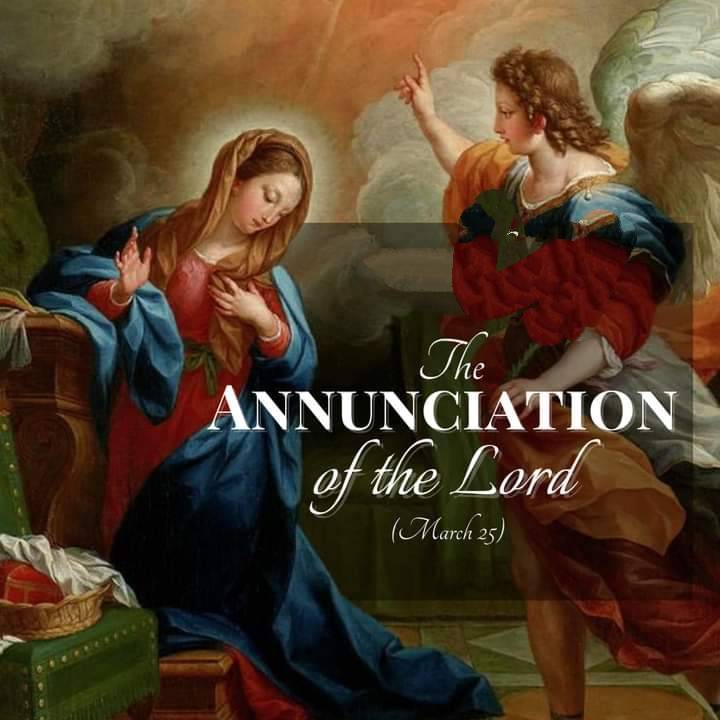
March 25 Wednesday: The Annunciation of the Lord: (Lk 1:26-38
The Solemnity of the Annunciation is celebrated nine months before the Nativity of the Lord. It marks the moment when the Archangel Gabriel appeared to the Virgin Mary and revealed God’s plan that she would become the Mother of the Son of God. At her “Yes,” the mystery of the Incarnation took place, “the Word became flesh and dwelt among us” (John 1:14). Because of this, the feast is sometimes called “Little Christmas,” a quiet but profound beginning of our salvation.
This feast reminds us that God often works in hidden and unexpected ways. As Fulton J. Sheen observed, divinity is often found where one least expects it. Mary’s humility, faith, and openness made her the chosen vessel of God’s saving plan. Even today, moments of announcement, like the joyful news of a child, echo something of that first Annunciation, though none compares to the moment when God entered human history.
Historical note
The celebration of the Annunciation began in the Eastern Church around the 5th century, likely after the Council of Ephesus, which affirmed Mary as the Mother of God. By the 7th century, the Western Church had fixed the feast on March 25, exactly nine months before Christmas.
God’s promises fulfilled
Today’s readings reveal how God begins to fulfill His promises across salvation history:
- To Adam and Eve, the promise of a Redeemer (Genesis 3:15).
- To King David, the promise of an everlasting kingdom through his descendant (2 Samuel 7:12–16).
- To King Ahaz, the prophecy that a virgin would bear a son called Emmanuel, “God with us” (Isaiah 7:14).
The Letter to the Hebrews (10:4–10) explains that the Incarnation is about perfect obedience, Christ comes to do the Father’s will, offering himself for our salvation. The Gospel presents Mary’s faithful response, her complete surrender to God’s plan.
Life messages
- We are called to say “Yes” to God’s will.
Mary’s response teaches that God’s plan must take priority over our own. Like her, we are invited to listen, trust, and obey, even when we do not fully understand (Luke 1:38). - We are invited to cooperate with grace.
As Augustine of Hippo teaches, God created us without our consent, but He will not save us without it. Our salvation involves our free and faithful cooperation with His will. - We must live in gratitude.
Through Christ, we become adopted children of God by grace (Galatians 4:4–7). Like Mary, we are called to recognize God’s goodness and respond with thanksgiving and love. - We are to become instruments of God’s presence.
The Annunciation is not only an event to remember but a mystery to live. We allow Christ to be “born” in us when we reflect his love, mercy, and goodness in our daily lives (Matthew 5:16). - We are called to humility and trust.
Mary’s greatness lies not in power but in humility. When we entrust ourselves to God’s plan, even in small daily decisions, we become part of His saving work. God bless you.
March 26 Thursday; Jn 8:51-59
In today’s Gospel (John 8:51–59), Jesus makes a series of bold and startling claims that both astonish and anger his listeners.
First, he declares that whoever keeps his word will never see death (John 8:51). The Jews immediately object, pointing out that even great figures like Abraham died. They fail to understand that Jesus is speaking about eternal death, separation from God, not merely physical death.
Second, Jesus claims a unique and intimate knowledge of God, saying that he knows the Father because he comes from Him (John 8:55). This challenges the Jewish conviction that God had already fully revealed Himself through the Law and the prophets.
Third, Jesus speaks of his perfect obedience to the Father. Unlike all others, his thoughts, words, and actions are in complete harmony with God’s will (John 8:29). While the Jews revere their ancestors and prophets as obedient servants of God, Jesus presents himself as the Son who lives in perfect unity with the Father.
Finally, Jesus makes his most striking claim, “Before Abraham was, I AM” (John 8:58). Here, he not only places himself before Abraham in time but also identifies himself with the divine name revealed to Moses (Exodus 3:14). This is a clear claim to divinity. Unable to accept this, the Jews attempt to stone him for blasphemy, but Jesus withdraws from them.
Life messages
- We are called to trust in Jesus’ divine identity.
Jesus is not just a teacher or prophet. His words carry divine authority. Believing in him means entrusting our lives to him and holding firmly to his teachings (John 14:6). - We must live what we believe.
Faith is not only about accepting truths but about obedience. If we believe that Jesus gives eternal life, we must follow his word in our daily choices (James 1:22). - We are invited into a personal relationship with Christ.
Since Jesus is present in every aspect of our lives, we can speak to him freely in prayer and learn to listen to his voice (John 10:27). - We must remain humble before God’s revelation.
Like the Jews, we can sometimes limit God to our own expectations. True faith requires openness to God’s mystery, even when it challenges our understanding (Isaiah 55:8–9). God bless you.
March 27 Friday; Jn 10:31-42
In today’s readings, both the prophet Jeremiah and Jesus face rejection, misunderstanding, and false accusations. In the first reading (Jeremiah 20:10–13), the prophet laments how even his friends turn against him, watching for his downfall. Yet, in the midst of this suffering, he places his trust in God, confident that the Lord will vindicate him.
In the Gospel (John 10:31–42), Jesus faces a similar situation. He is accused of blasphemy and nearly stoned because he claims unity with God. This is not the first time such an accusation is made, earlier, when he forgave the sins of the paralytic, he was also called a blasphemer (Matthew 9:1–8). Later, during his trial before the Sanhedrin, the charge would be repeated when he openly affirmed his divine identity (Matthew 26:63–65).
Two arguments supporting Jesus’ Divinity
- Scriptural argument
Jesus refers to Psalm 82:6, “You are gods, sons of the Most High,” where human judges are called “gods” because they act on God’s behalf in administering justice. If Scripture can use such language for those who represent God, how much more fitting is it for the one who is truly consecrated and sent by the Father? Jesus’ claim is not blasphemy but a revelation of his true identity as the Son of God (John 10:34–36). - The witness of his works
Jesus points to his miracles as evidence. These works are not merely signs of power but signs that the Father is acting through him. “The Father is in me and I am in the Father” (John 10:38). Even if his listeners struggle to accept his words, they are invited to believe because of his deeds, which reveal God’s presence and action.
Despite these arguments, many still refuse to believe. Yet others begin to see and accept the truth about him.
Life messages
- We are children of God through Baptism
Through Baptism, we are made sons and daughters of God, sharing in His divine life and called to eternal inheritance (Romans 8:14–17). - We are called to witness to Christ
Like Jeremiah and Jesus, we may face misunderstanding or opposition. But we are consecrated and sent to bear witness to Christ by living his teachings with courage and fidelity (Matthew 5:16). - We must trust God in times of trial
Jeremiah’s confidence reminds us that God stands with those who are faithful. Even when we are misunderstood or rejected, God remains our strength and defender (Psalm 27:1). - Our lives should reflect Christ’s presence
Just as Jesus’ works revealed the Father, our actions should reflect Christ in us. Our love, mercy, and integrity become living signs that God is at work (James 2:17). God bless you.
March 28 Saturday: Jn 11:45-56
Today’s Gospel (John 11:45–56) presents the reaction of the religious authorities after Jesus raised Lazarus from the dead. News of this extraordinary miracle spreads quickly, prompting the chief priests and Pharisees to convene the Sanhedrin. Instead of leading them to faith, the miracle deepens their fear and hostility.
To understand their reaction, we must consider the context. A large part of the population of Jerusalem depended on the Temple for their livelihood and social stability. Supporting Jesus, who challenged certain practices and authority structures, could threaten not only religious order but also economic security. Moreover, there was constant fear of Roman intervention. History had shown that any sign of unrest could provoke violent suppression (cf. Acts 5:35–37). So, for many, rejecting Jesus seemed like a way of preserving peace and survival.
At the center of this discussion is Caiaphas, the High Priest. He argues that “it is better that one man die for the people than that the whole nation perish” (John 11:50). On the surface, this is a political calculation, he sees Jesus as a threat whose death could prevent Roman retaliation.
Yet, as the Gospel reveals, his words carry a deeper, prophetic meaning. Without fully realizing it, Caiaphas speaks under divine inspiration. His statement points to the saving mission of Christ, that Jesus would die not only for Israel but to gather together all God’s scattered children into one (John 11:51–52). What is meant as a strategy for political survival becomes, in God’s plan, the proclamation of universal redemption.
This fulfills the hope expressed by the prophets, that God would gather a new people, not limited to one nation but open to all who believe (cf. Isaiah 49:6). Through his death on the Cross, Jesus establishes the new Israel, the Church, uniting all in one Body.
Life messages
- We are called to reflect on Christ’s sacrifice.
As we approach Holy Week, we are invited to remember with gratitude that Jesus freely gave his life for the salvation of all (John 10:11). - We must respond with repentance and renewal.
Christ’s death calls us to turn away from sin and renew our lives in faith and love (Acts 3:19). - God can bring good even from human wrongdoing.
Caiaphas intended harm, yet God used his words to reveal a greater truth. This reminds us that God’s plan is never defeated by human weakness (Romans 8:28). - We are called into unity in Christ.
Jesus died to gather all into one family. We are invited to live this unity through love, forgiveness, and communion with others (Ephesians 2:14–16). God bless you.

Thank you and God bless you for these piece
Amen