






Feb 9 Monday: Mk 6: 53-56
Gennesaret was a fertile tract of land about four miles long on the western shore of the Sea of Galilee, stretching between present-day Tabgha and ancient Magdala. It was often called the “Paradise of Galilee” because of its rich soil and abundant harvests. Farmers grew walnuts, dates, olives, figs, and grapes, while its shoreline supported a thriving fishing industry. When Jesus unexpectedly landed on the shore of Gennesaret, the people immediately recognized him as the preacher and healer whose fame had spread throughout the region.
Today’s Gospel passage describes their intense reaction. They saw this moment as a rare opportunity to hear Jesus and to have their sick healed. With great trust in his divine power, they brought the sick to him and begged that they might at least touch the fringe of his garment. Their faith was so strong that they believed even this simple gesture would bring healing, and the Gospel tells us that all who touched him were healed. Yet it is possible that many of them were more interested in physical healing than in the deeper spiritual conversion that Jesus’ preaching demanded.
This reveals a tendency that still exists in human life. As fallen people living in a broken world, we are often tempted to use others for what we can gain from them. At times, we treat God the same way. We turn to him urgently when sickness strikes, when problems overwhelm us, or when tragedy enters our lives, but we forget to thank him or to remain close to him when things go well. Some people approach the Church only for Baptism, Marriage, or burial, without committing themselves to a living relationship with Christ and the community. Even in families and friendships, people can sometimes take without giving, enjoying support and care while offering little in return.
Life messages:
- A healing far greater than physical healing is available to us in the Sacrament of Reconciliation. There, Jesus heals the wounds of sin, guilt, and broken relationships. We should desire the confessional with even greater longing than the crowds of Gennesaret desired bodily healing.
- Instead of using God only in moments of need, let us learn to live constantly in his presence and to recognize his presence in the people around us.
- When we bring our needs to the Lord, let us do so with expectant faith, gratitude, and a sincere promise to cooperate with his grace by doing his will.
- Finally, we should ask ourselves honest questions. Do we hasten to Mass with eagerness? Do we hurry to bring others to Jesus through prayer, example, and encouragement? Do we hasten to pray with our children at night? Do we hasten to recognize the face of Christ in our neighbors, especially the poor and the suffering? God bless you.
Feb 10 Tuesday: St. Scolastica, Virgin. Mk 7:1-
Today’s Gospel passage describes Jesus being confronted by the scribes and Pharisees who had been sent from Jerusalem by the Sanhedrin, the supreme religious council of the Jews, to examine what they considered his “heretical teachings.” Their first accusation concerned ritual purity. They questioned why Jesus did not command his disciples to observe the ritual washing of hands before meals.
In the Book of Exodus, rules were given for priests to wash their hands before offering sacrifice (Exodus 30:17–21). Over time, Jewish tradition extended this priestly purification to all Jews before every meal, in order to give ordinary daily activities a religious meaning. Ritual washing was meant to symbolize the inner moral purity required when approaching God, a clean conscience and a pure heart. However, by the time of Jesus, the Pharisees had reduced this practice to a rigid external observance, detached from its original spiritual purpose.
Jesus therefore restored the authentic meaning of the Law. He reminded them that God’s commandments were given not for show, but to shape the heart and guide people into a genuine relationship with Him. Jesus shocked his accusers by calling them hypocrites. He accused them of honoring God with their lips while their hearts were far from Him, replacing God’s commandments with human traditions.
To illustrate this hypocrisy, Jesus referred to their misuse of the law of Korban. According to this distorted interpretation, a person could avoid caring for elderly parents by declaring money or property as “Korban,” meaning dedicated to God. By doing so, they appeared religious while actually violating God’s clear commandment to honor father and mother. Jesus made it clear that such behavior did not please God. True defilement, he taught, does not come from external things, but from the human heart, from evil intentions, selfishness, pride, and lack of love. Religion that is reduced to external observances without inner conversion becomes empty and misleading.
Life messages:
- The heart of religion is a living, personal relationship with God and with other human beings, not the mere performance of external rituals. External practices have value only when they express inner faith, obedience, and love.
- God expects from us what He continually gives us through Jesus, generous love. He calls us to show mercy, practice kindness, forgive readily, and serve others with humility and sacrifice. True worship of God is shown in how we treat others. God bless you.
Feb 11 Wednesday: Our Lady of Lourdes: Mk 7: 14-23
Nothing that enters one from outside can defile that person” (Mk 7:15)
Today Jesus teaches us a liberating truth: everything God has created is good. What truly defiles a person is not what comes from outside, but what arises from within, from a heart guided by wrong intentions. That is why Jesus says, “Nothing that enters one from outside can defile that person; but the things that come out from within are what defile.”
The experience of offending God is very real. Christians quickly recognize the deep mark of sin in the human heart and in a world wounded by selfishness, pride, and injustice. The mission Jesus entrusts to us is therefore clear, to help cleanse this world, with the power of his grace, from the contamination introduced by sinful human intentions.
The Lord asks us to carry out all our human activities well. He expects intensity, order, competence, and a sincere desire for excellence, not for self-glory, but to restore God’s original creative plan, which made everything good and intended it for the good of humanity. As Saint Josemaría reminds us, purity of intention consists in seeking, always and in everything, only to please God.
It is our own will that can distort God’s plan. Vanity, self-love, discouragement born of weak faith, impatience when results do not come quickly, all these can corrupt even good actions. For this reason, Saint Gregory the Great warns us not to be deceived by apparent success or comfort. A traveler who stops for pleasant meadows and forgets his destination risks losing his way.
We must therefore remain attentive in offering our daily work to God. By cultivating the presence of God and frequently reflecting on our divine filiation, our entire day, prayer and work together, draws its strength from the Lord. When our actions begin in Him and are offered for Him, they serve His saving purpose.
When united to Christ, even the simplest human actions become co-redemptive. In this way, nothing in our lives is wasted, and everything, purified by right intention and grace, contributes to God’s work of salvation. God bless you.
Feb 12 Thursday: Mk 7:24-30
Homily: Faith That Crosses Boundaries
In today’s Gospel, Jesus reveals clearly that salvation is not reserved for one people alone but is offered to all who approach God with trusting faith. By healing the daughter of a Gentile woman, Jesus shows that God’s mercy knows no ethnic, cultural, or religious boundaries. What opens the door to God’s saving power is not ancestry or privilege, but faith that perseveres.
This healing is the second of three significant miracles in which Jesus responds to Gentiles. Earlier, he had freed the demon-possessed man in the region of the Gerasenes, restoring him to life and dignity. Later, he would heal the servant of a Roman centurion, praising that Gentile’s faith as greater than any he had found in Israel. Together, these miracles quietly prepare the way for the universal mission of the Church and anticipate the command to preach the Gospel to all nations.
At first, Jesus appears silent and unresponsive to the desperate cries of the woman. Even his disciples grow impatient and ask that she be dismissed. Then comes what seems like a refusal, spoken in language that tests the woman’s resolve. In reality, Jesus is not rejecting her but drawing out the depth of her faith. Three times she is met with obstacles, yet she does not turn away. Instead, she persists with humility, honesty, and courage.
The woman recognizes Jesus as the Messiah when she calls him “Son of David.” She does not argue her worthiness but pleads simply for mercy. She accepts her lowliness without resentment and trusts completely in the goodness of Jesus. Her perseverance echoes other moments in Scripture where God responds to persistent faith, such as Jacob wrestling with God for a blessing, or the widow who would not stop pleading with the unjust judge. In the end, Jesus is moved by her confidence and humility and declares, “Woman, great is your faith. Let it be done for you as you wish.” Her daughter is healed instantly.
Life messages
- This Gospel calls us to perseverance in prayer. Jesus himself urges us to ask, seek, and knock, not once, but continually. Persistent prayer is not a sign of doubt but of deep trust. God does not always answer according to our timetable or in the exact form we request, but He always responds with what is truly best for our salvation.
- We are challenged to break down the walls we build through pride, prejudice, and exclusion. God’s love is universal, and the Church is called to reflect that universality. Anyone who approaches God with sincere faith is welcomed into His mercy. Today’s Gospel invites us to examine our hearts and pray that all barriers which divide us from others may fall, so that we may share fully in the wideness of God’s saving love. God bless you.
Feb 13 Friday: Mk 7:31-37
: “Be Opened”
Today’s Gospel recounts how Jesus healed a man who was deaf and unable to speak clearly. Through this miracle, Jesus fulfills the ancient Messianic promise announced by the prophet Isaiah: “The eyes of the blind shall be opened, and the ears of the deaf unstopped” (Isaiah 35:5). What we see here is not only a physical healing but a powerful sign of God’s saving action, restoring human dignity and drawing people back into full communion with others and with God.
This Gospel challenges us in two directions. First, it calls us to become humble instruments in Jesus’ hands, people who help give a voice to the weak, the excluded, and the forgotten in society. Second, it invites us to allow Jesus to open our own ears to hear God’s word and to loosen our tongues so that we may proclaim the Good News of God’s love and salvation. In Mark’s Gospel, this miracle also highlights a constant theme of Jesus’ ministry, that no one can truly follow him without reaching out to the helpless and the poor.
Mark carefully describes the healing in seven deliberate, almost ritual-like actions. Jesus takes the man away from the crowd, puts his fingers into his ears, touches his tongue with saliva, looks up to heaven, sighs deeply, and then speaks the word, “Ephphatha,” meaning “Be opened.” Immediately, the man’s ears are opened and his speech is restored. Jesus likely uses these gestures because the man cannot hear spoken words or explain his need. By touch, by sight, and by compassion, Jesus communicates healing.
The use of saliva reflects the cultural belief of the time that the spittle of holy persons had healing power. Yet the deeper meaning goes beyond the physical act. This miracle symbolizes the opening of the human person to God. The ears are opened to receive God’s word, and the tongue is loosened to confess faith and proclaim praise. What Jesus does outwardly to this man, he desires to do inwardly for every believer.
Life messages
- Jesus wants to touch our lives so that we may become his voice in today’s world. He opens our hearts so that, through us, he may speak hope, mercy, and truth to those who are spiritually hungry and wounded.
- We must allow Jesus to heal our spiritual deafness and muteness. When we are closed to God, prayer becomes difficult and Scripture sounds distant. Only Christ can open our ears to hear God speaking through the Bible and through the teaching of the Church.
- Like the man in the Gospel, we are invited to seek Jesus away from the noise of the crowd. By spending time with him in prayer, reflecting on Sacred Scripture, and growing in a personal relationship with him, we gradually experience his healing presence. This encounter opens our ears to God’s voice and loosens our tongues to bear witness to what the Lord has done for us. God bless you.
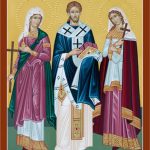
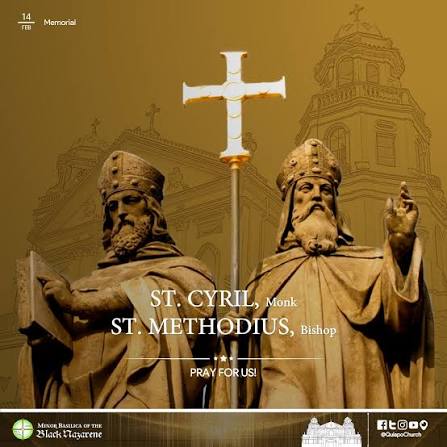
Feb 14 Saturday: St. Cyril, Monk; St. Mehodius, Bishop. Mk 8:1-10
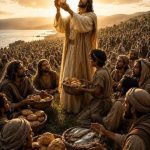
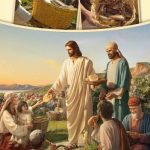
The miraculous feeding described in today’s Gospel took place on a hill near the Sea of Galilee, after Jesus returned from the Decapolis. A large crowd stayed with him for three days, listening to his preaching and witnessing his healing ministry, until all the food they had brought with them was exhausted.
Moved with compassion for the hungry crowd, Jesus instructed his Apostles to feed them with what they had, seven loaves of bread and a few small fish. They brought these to Jesus, who gave thanks, broke the bread, and asked his disciples to distribute the food to the people. After everyone had eaten and was satisfied, the Apostles collected seven baskets full of leftover pieces.
This miracle closely resembles an earlier feeding, but there are important differences. In the first miracle, Jesus fed a Jewish crowd, while this one was performed for Gentiles. In the earlier account, twelve baskets of leftovers were collected, here only seven. The language used by the evangelist is clearly Eucharistic. Jesus took the bread, gave thanks, broke it, and gave it to his disciples to distribute.
Life messages:
- We need to help Jesus feed the hungry today. Jesus invites us to give him our hearts so that, through us, he may touch the lives of people in our own time, just as he worked through holy men and women such as Francis of Assisi, Damien of Molokai, Vincent de Paul, and Mother Teresa. We are called to feed the spiritually hungry with words and actions of kindness, mercy, and self-giving love.
- We need to be fed by Jesus in order to feed others. Jesus continues to nourish us in his Church through the Word of God and through his own Body and Blood in Holy Communion, strengthening us so that we may become bread broken for the life of the world. God bless you.