

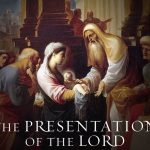






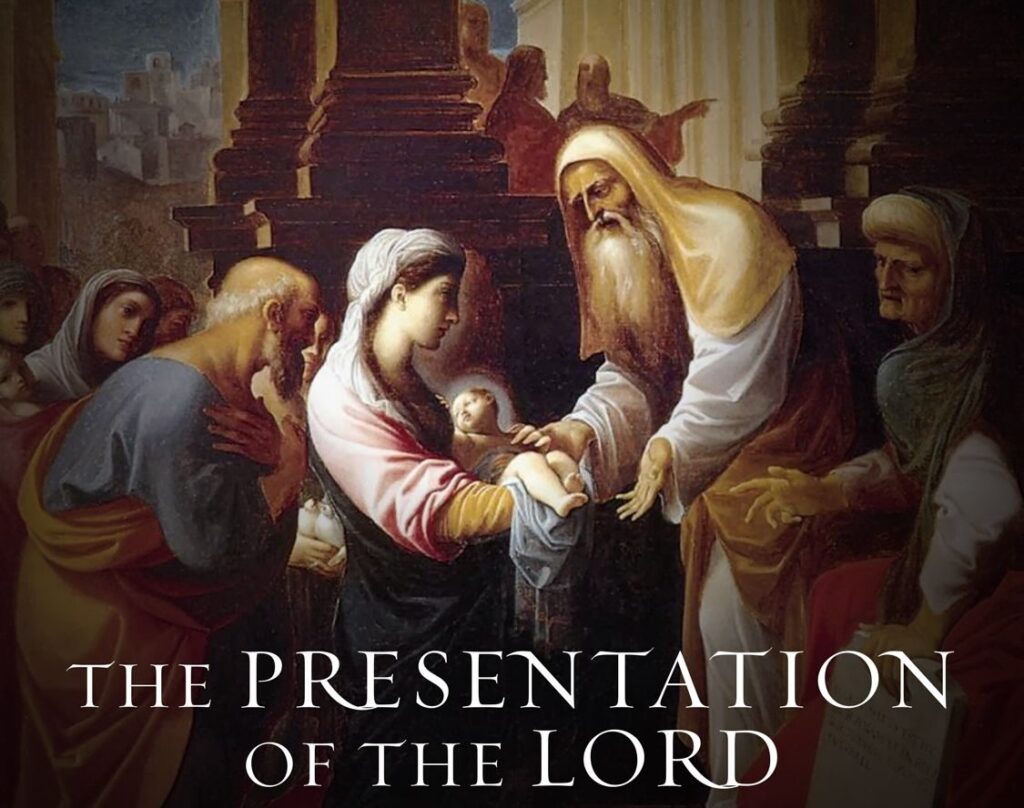
Feb 2 Monday: The Presentation of the Lord: Lk 2: 22-40 or Lk 2: 22-32.
Today’s Gospel presents Saint Joseph, the head of the Holy Family, as a man of quiet obedience, faithfully observing the Law of Moses by bringing Mary and the Child Jesus to the Temple in Jerusalem. In doing so, Joseph fulfills both the purification rites prescribed for the mother after childbirth and the presentation and redemption of the firstborn son. Although these events appear elsewhere in the liturgical year, the Church traditionally celebrates them today, February 2, in the Feast of the Presentation of the Lord.
This feast beautifully brings together several dimensions of Jewish and Christian faith. It recalls the purification of Mary, observed through prayer and the offering of two birds in the Temple, a sign of the Holy Family’s poverty and humility. It also commemorates the presentation of Jesus, the firstborn male, who according to the Law belonged entirely to the Lord and had to be redeemed by the payment of five shekels to a priestly family member. In addition, the feast is known as the Feast of Encounter, because here the Old Testament, represented by Simeon and Anna, meets show fulfillment in the New Testament, represented by the infant Jesus. For this reason, the celebration also marks the formal close of the Christmas season. On this same day, the Church celebrates Candlemas, blessing candles that symbolize Christ, the true Light who has come into the world.
The purification and redemption rituals reveal deep theological meaning. According to the Law, every firstborn male belonged to God and had to be “bought back” in a ritual known as Pidyon haBen. At the same time, every mother was required to undergo purification after childbirth, offering a lamb or, in the case of the poor, two turtledoves or pigeons. Although Mary was free from all stain of sin and Jesus was the Son of God himself, Joseph and Mary humbly submitted to the Law. Their obedience teaches us that holiness expresses itself not in exemption from God’s commands, but in loving faithfulness to them.
At the heart of the Gospel is the encounter with Simeon and Anna. Moved by the Holy Spirit, Simeon, a righteous and devout man, recognizes in the child the long-awaited salvation of Israel. In his hymn of praise, he proclaims Jesus as a light for revelation to the Gentiles and the glory of God’s people Israel. Simeon’s blessing, however, also carries a prophecy of suffering. He foretells that Jesus will be a sign of contradiction and that a sword will pierce Mary’s soul, pointing forward to the Passion and the cost of redemption. Anna, advanced in years and constant in prayer, also recognizes the child and speaks of him to all who were awaiting the redemption of Jerusalem. Together, these two elderly witnesses represent the faithful remnant of Israel, ready to welcome God’s saving work.
Life message.
Every Holy Mass we attend is, in a real sense, our own presentation before the Lord. Though we were formally presented to God at our Baptism, we continue to place ourselves and our loved ones on the altar at each Eucharistic celebration through Jesus Christ. This calls us to live with the awareness that we are a consecrated people, set apart for God, and therefore obliged to pursue lives of holiness. On this feast, we are also invited to remember with gratitude and prayer our godparents, who first presented us to the Lord and promised to help us grow in faith. God bless you.
References and Sources
Sacred Scripture:
Luke 2:22–38
Exodus 13:1–2, 11–16
Numbers 3:47–48; 18:15
Malachi 3:1
Catechism of the Catholic Church:
Christ as Light of the nations, nos. 528–529
Mary’s obedience and faith, nos. 494–507
Church Documents and Fathers:
Second Vatican Council, Lumen Gentium, no. 58
St. Bede the Venerable, Homilies on the Gospels
St. Ambrose, Exposition of the Gospel of Luke
Reputable Catholic Sources:
United States Conference of Catholic Bishops, Biblical Commentary
Catechism of the Catholic Church, Vatican edition
Catholic Encyclopedia and Patristic collections
Feb 3 Tuesday: Mk 5: 21-43 (St. Blaise)
Today’s Gospel presents two powerful miracles, one of healing and one of restoration to life. Both are signs of Jesus’ compassion and mercy, and both are responses to Faith that is real but imperfect. A synagogue ruler pleads for his dying daughter, and a woman suffering from a hemorrhage secretly reaches out to touch Jesus’ garment. Though their Faith is mixed with fear, desperation, and even misunderstanding, Jesus responds generously to both.
The synagogue ruler was a respected leader and a defender of Jewish religious tradition. People like him usually kept their distance from Jesus, who was known for mixing with sinners and challenging religious authorities. Yet when his daughter was close to death and every medical option had failed, he put aside pride and fear and came to Jesus. His Faith may have begun in desperation, but it grew into courage. Even when news arrived that the child had died, he did not abandon Jesus, despite the ridicule of those around him. In Jewish belief, a person was not considered fully dead until three days had passed. Still, Jesus encouraged him to keep believing, and his trust was rewarded when his daughter was restored to life.
Alongside this story is the quiet courage of a suffering woman. For twelve long years she had endured constant bleeding, which made her ritually unclean according to the Law. This meant exclusion from public worship and social life. She was not supposed to be in a crowd at all. Yet her suffering and her Faith pushed her beyond fear. Believing that even touching the fringe of Jesus’ garment would heal her, she approached him from behind. Her Faith carried a trace of superstition, but it was sincere. Jesus did not rebuke her. Instead, he affirmed her dignity, calling her “daughter,” and publicly restored her not only to health, but also to the community.
In both cases, Jesus brings life where there was loss, and hope where there was despair. The woman is restored to wholeness and belonging. The child is restored to her family and to life itself. These miracles reveal that Jesus is not offended by weak or imperfect Faith. He meets people where they are and leads them forward.
Life message.
Jesus accepts us as we are. We do not need perfect motives or flawless Faith to approach him. What he desires is our trust, however fragile it may be. Like the synagogue ruler and the suffering woman, we are invited to bring our physical, emotional, and spiritual wounds to Jesus today, confident that his healing touch can restore life, dignity, and hope. God bless you.
Feb 4 Wednesday: : Mk 6:1-6
Today’s Gospel passage describes the scorn of bland indifference and the sharp edge of jealousy that Jesus faced when he preached in the synagogue of his hometown, Nazareth. The people who had watched him grow up as a simple carpenter now saw him teaching with authority, surrounded by disciples, and speaking with wisdom that clearly came from God. Instead of faith, their response was suspicion, envy, and rejection.
A prophet without honor.
The synagogue was crowded. The people came expecting wonders. They had heard of the miracles Jesus worked in neighboring towns and villages, and they wanted the same display for themselves. Yet their hearts were closed. They could not accept that someone so familiar, someone they thought they knew so well, could be God’s chosen prophet. Their jealousy was sharpened by the fact that Jesus had no formal rabbinical training. A carpenter, a profession considered low in social status, was now interpreting Scripture with authority. This offended their pride.
They also struggled with his background. Jesus came from a family they regarded as ordinary and insignificant. His relatives were known to them and held no special status. Worst of all, Jesus challenged them directly by pointing out their lack of faith. He reminded them that the prophets Elijah and Elisha were sent not to unbelieving Israelites, but to Gentiles who trusted God. This comparison wounded their national and religious pride and sealed their rejection of him. Because of their unbelief, Jesus worked few miracles there, not because he lacked power, but because faith was absent.
The question of Jesus’ brothers and sisters.
The Gospel mentions Jesus’ “brothers” and “sisters,” which has often been misunderstood. In ancient Hebrew and Aramaic, there were no precise words for different degrees of family relationship. The term “brothers” was commonly used for close relatives, members of the same clan, or extended family. The Gospels themselves clarify that the individuals named as Jesus’ “brothers” were not children of Mary. Elsewhere, these same men are identified as sons of another woman named Mary. Jesus himself is consistently identified as the son of Mary, and the Church has always taught as a matter of faith that Mary remained ever-virgin. This belief has been held from the earliest centuries of Christianity.
Life messages.
First, many of us have experienced rejection, misunderstanding, or hurt from our own families or close friends. Jesus understands that pain. When we face such rejection, we are invited to respond with courage, patience, and trust in God’s will.
Second, we must be careful not to imitate the people of Nazareth by allowing familiarity to dull our faith. God can speak to us through ordinary people and unexpected situations.
Third, our society needs Spirit-filled Christians who are willing to speak God’s truth with humility and conviction, even when it is unpopular.
Finally, trusting faith in the divinity and goodness of Christ is essential if Jesus is to work powerfully in our lives. When the Gospel or the teaching of the Church challenges us, we should receive it with gratitude, allowing the Holy Spirit to transform us rather than silencing God’s prophetic voice in our hearts. God bless you.
Feb 5 Thursday: St. Agatha, Virgin, Martyr: Mk 6:7-13
Today’s Gospel describes the commissioning of the Twelve Apostles. Jesus sent them out in pairs with power and authority over demons and with the ability to cure diseases, to go ahead of him to the people and places he intended to visit. Their mission was to preach the coming of the Kingdom of God, that is, God’s rule in the lives of the people. They were also to show those who listened how to prepare their hearts for God’s rule, by repenting of their sins and seeking God’s forgiveness and freedom from sinful habits.
The Apostles were expected to follow Jesus’ clear and demanding action plan. From his instructions, it is evident that they were to take no supplies for the journey. They were to trust completely in God the Provider, believing that he would open the hearts of believers to care for their needs. These instructions also show that Jesus did not want his disciples to imitate the acquisitive priests of the time who were interested mainly in material gain. Instead, the Apostles were to be living examples of God’s love, simplicity, and providence.
In Jewish society, hospitality was a sacred religious duty. The people considered it both a privilege and an obligation to support their rabbis. Jesus therefore instructed his Apostles to stay in one reputable household, bless the family with God’s peace, accept gratefully the food and lodging offered, and resist the temptation to seek better accommodation. Their task was clear and demanding, to preach that the Kingdom of Heaven was at hand, heal the sick, raise the dead, cleanse lepers, and cast out demons.
Life messages
- We all have a witnessing mission. Every Christian is called not only to be a disciple, but also to be an apostle, a witness to Christ. We evangelize not merely through words, ideas, or doctrines, but through our lived experience of God. By our transparent Christian lives, we are meant to reveal Jesus as we have encountered him, as one who loves unconditionally, forgives generously, and shows deep concern for those around us.
- We also have a liberating mission. Many modern-day demons enslave people and rob them of their freedom, addictions to nicotine, alcohol, drugs, gambling, pornography, promiscuity, as well as the powerful forces of materialism, secularism, and consumerism. We need the help of Jesus to be liberated ourselves, and to help others experience the fullness of freedom that only he can give. God bless you.
Feb 6 Friday: St. Paul Miki and Companions, Martyrs. Mk 6:14-29
Who is Jesus?
The text begins with a survey of the different opinions people held about Jesus, including the opinion of Herod. Some identified Jesus with John the Baptist, others with Elijah, and still others with one of the prophets. In this way, people tried to understand Jesus using what they already knew, believed, and hoped for. They interpreted him through familiar Old Testament categories of prophecy and through the traditions of the ancestors with their laws and expectations. Yet these criteria were insufficient. Jesus could not be contained within them, because he went beyond them all.
The cause of John’s death.
Galilee, the land of Jesus, was governed by Herod Antipas, the son of Herod the Great, from 4 BC to AD 39, a reign of about forty-three years. Throughout Jesus’ entire lifetime, there was no change in the government of Galilee. Herod Antipas ruled as an absolute lord, listening to no one and acting according to his own will. In reality, however, the real power in Palestine rested with the Roman Emperor, represented locally by a Roman procurator. To retain his position, Herod sought to please Rome in every possible way, especially through efficient administration that ensured steady revenue for the empire.
Herod was primarily concerned with his own security and advancement. For this reason, he suppressed any form of opposition or unrest. The historian Flavius Josephus explains that John the Baptist was imprisoned because Herod feared that John’s influence could lead to a popular uprising. Although Herod liked to be called a benefactor of the people, in truth he ruled as a tyrant. John’s public condemnation of Herod’s immoral conduct became the final trigger that led to John’s imprisonment.
The murder plot.
The setting of John’s execution was a birthday banquet marked by excess, drinking, and moral corruption. Such banquets were occasions where political alliances were forged and power was displayed. Present were the leading figures of the court, military officers, and prominent citizens of Galilee. In this atmosphere, the murder of John the Baptist was planned. John, as a prophet, stood as a living accusation against a corrupt system, and for this reason he had to be silenced. His death was carried out under the pretext of a personal vendetta.
This episode exposes Herod’s moral weakness. He possessed immense power, yet lacked self-control. Swept up by the excitement of the feast and influenced by wine, Herod made a reckless oath to the young dancer. Bound by superstition and fear of losing face before his guests, he chose to preserve his honor rather than protect an innocent life. To Herod, the lives of his subjects had little value. He treated them as objects to be used or discarded at will. The evangelist narrates these events with restraint, allowing the community to draw its own conclusions.
Personal questions.
Do we know of people who have died as victims of corruption and the abuse of power? Are there individuals in our communities or even within the Church who suffer because of authoritarian leadership or the excessive concentration of power?
Herod, who believed he held power over life and death, was also deeply superstitious. He feared that John the Baptist, whom he had unjustly killed, had risen from the dead. He appears as a man who was cowardly before the powerful and morally weak before the powerless. Superstition, cowardice, and corruption marked his exercise of authority. This invites us to reflect seriously on the way religious and civil power is exercised today at various levels of society and within the Church. God bless you.
Feb 7 Saturday: Mk 6:30-34
Today’s Gospel passage reveals the tender and compassionate heart of Jesus, who gently invites his Apostles to withdraw with him to a quiet and deserted place for rest. Jesus knew that the Apostles, whom he had sent to preach and heal in the surrounding towns and villages, were physically and spiritually exhausted after their mission. He desired to give them time to rest, to regain strength, and also to listen attentively as they shared the joy and challenges of their missionary experiences. Yet their plan for rest was quickly interrupted, as large crowds gathered around them. Moved with deep compassion, Jesus set aside his own need for rest and began once more to teach, because he saw the people as sheep without a shepherd.
In this Gospel, Jesus clearly reveals himself as the Good Shepherd. Throughout the Old Testament, God is presented as the Shepherd of Israel, guiding, protecting, and caring for his people. The psalmist joyfully proclaims, “The Lord is my shepherd; there is nothing I shall want.” The prophet Isaiah foretold that the Messiah would shepherd his people with tenderness, gathering the lambs in his arms and carrying them close to his heart. Jesus fulfills these promises when he declares that he is the Good Shepherd who is willing to lay down his life for his sheep. Saint Peter later describes Jesus as the Shepherd and Guardian of our souls, the one who brings us back when we stray and restores us to life.
Life messages:
- We are invited to imitate the Good Shepherd by showing mercy, compassion, patience, and genuine concern to all those entrusted to our care, whether in our families, communities, or ministries.
- We are also called to be good sheep by listening attentively to the voice of Christ, living lives of humility and self-giving love, and drawing daily strength from the Body and Blood of Christ in Holy Communion, which nourishes and guides us on our journey of faith. God bless you.
References and sources:
– Psalm 23
– Isaiah 40:11
– John 10:11–15
– 1 Peter 2:25
– Catechism of the Catholic Church, sections on Christ the Good Shepherd
– Patristic reflections on Christ as Shepherd (Saint Augustine, Saint Gregory the Great)
